Build or Skip
Find products already making money before you build
A research database of products already showing payment signals, with revenue and tip rankings, backlink libraries, an API, and MCP access for AI agents.
About Build or Skip
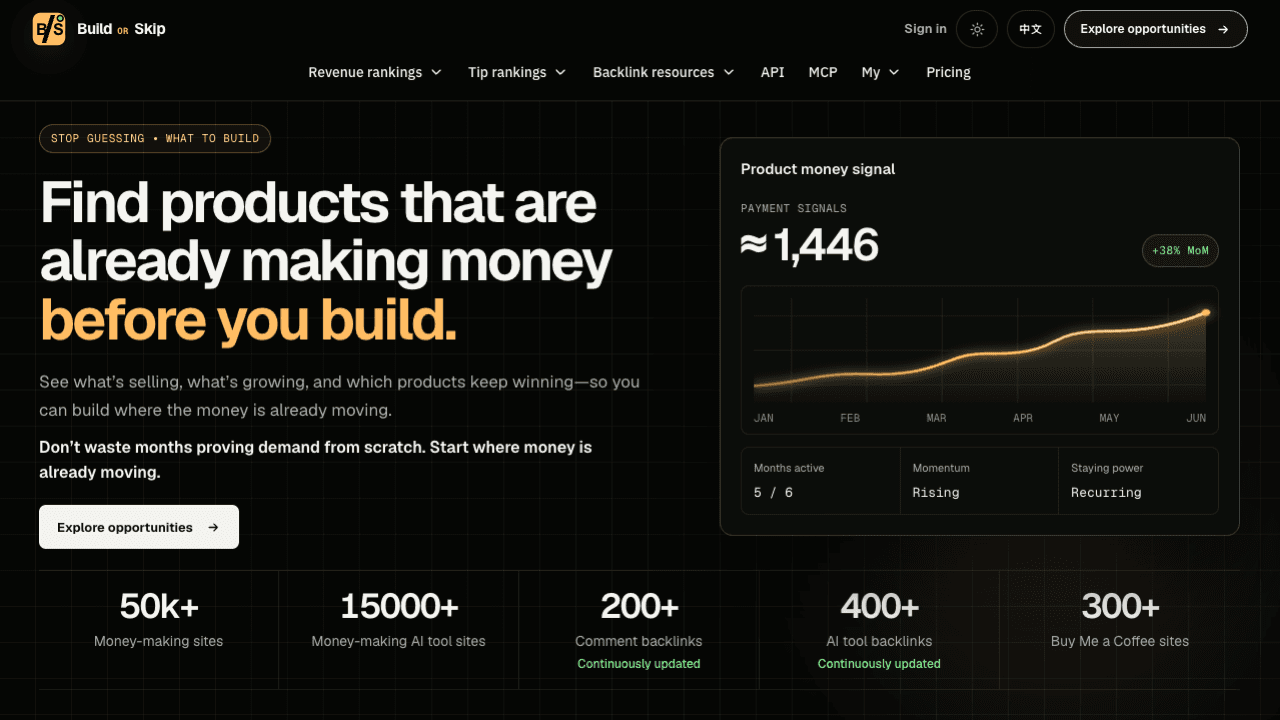
Build or Skip is a research database for people deciding what to build next. Rather than validating an idea from scratch, it starts from products that already show signs of commercial activity and lets you study them: which are selling, which are growing month over month, and which keep earning rather than spiking once. The premise is that months spent proving demand for something nobody wants is the most expensive mistake in independent software, and that public payment signals are a cheaper place to start than a survey.
What makes it more credible than most tools in this space is that it is careful about what its numbers are. The site states plainly that its figures are research signals and do not represent verified orders, revenue or customer counts. That matters, because the entire category is full of products quoting scraped revenue as though it were audited. Saying so on the homepage, rather than in a footnote, is the difference between a research tool and a rumour.
The data covers more than 50,000 money-making sites, over 15,000 of them AI tool sites, alongside 300+ Buy Me a Coffee pages used as a tipping signal. There is an API, and an MCP server with unlimited calls on the paid plan, which means an AI agent can query the dataset directly rather than a person reading tables.
Start from a ranking. The new site revenue ranking surfaces recently registered domains that are already showing payment signals, which is the closest thing here to catching something early. The product revenue ranking covers established products and can be filtered by product area, payment channel, domain rating, registration date and signal strength, with six-month momentum alongside.
Add evidence before deciding. For any candidate you can look at payment signals, public tips, domain registration date, DR, traffic, product category and backlink data, then judge whether the pattern is a real business or a spike. Momentum, months active and staying power are surfaced as separate measures, which is the right split: something earning for five of six months is a different proposition from something that earned once.
Freshness is stated rather than implied. Revenue rankings follow calendar-month reporting, the comment and AI tool backlink libraries update daily, and other site data carries its own date on the page.
- •Revenue and tip rankings - Products ranked by payment signals and by publicly visible Buy Me a Coffee tips, with six-month trends rather than a single snapshot.
- •New site ranking - Recently registered domains already showing payment activity, for finding things before they are obvious.
- •Momentum, active months and staying power - Separated out, so a consistent earner is distinguishable from a one-off spike.
- •AI tool backlink library - AI directories and resource sites listed with submission URL, whether a fee is required, whether a reciprocal link is required, and the date each was last checked.
- •Comment backlink library - Collected comment articles by domain and review date, linking to the original page so you can judge it yourself.
- •API and MCP access - Query DR, registration, monthly traffic and structured homepage data through the API, or connect an AI agent over MCP with unlimited calls on the paid plan.
Built for independent developers, indie hackers and small startup teams choosing between ideas, particularly anyone who has already lost a few months to something that turned out to have no buyers. The tip rankings are a genuinely unusual signal: people paying voluntarily for something they could use free is strong evidence of demand, and almost nobody else indexes it.
The AI tool backlink library is worth a separate mention for anyone launching a product, since it records which directories charge and which demand a reciprocal link before you spend a day on submissions.
Two honest caveats. The data is inference from public signals, not accounts, and the vendor says so, so treat a ranking as a shortlist rather than a verdict. And the free tier is a preview: meaningful research needs the paid plan, which is $19 a month or $15.83 billed yearly.