
If you go to rewind.ai today you will find a working website. It has a logo, a pricing page, four tiers, and a signup button. Everything about it says this is a live product you can buy.
It is not Rewind. It has nothing to do with Rewind. The company that made the Mac app you are looking for does not exist under that name any more, the app stopped recording on 19 December 2025, and the site you are looking at belongs to somebody else entirely.
This one caught me out in a way that is slightly embarrassing, because I run a tools directory and my own database fell for it. I will get to that part.
The timeline, in three names
Rewind AI was a Mac app that recorded your screen and your audio continuously, stored it locally, and let you search it. Scrub back to what you were looking at on Tuesday. Find the thing somebody said on a call when you were not taking notes. It was one of the few AI products where the pitch was obvious the moment you saw it, and one of the few that took local-first storage seriously rather than as a marketing line.
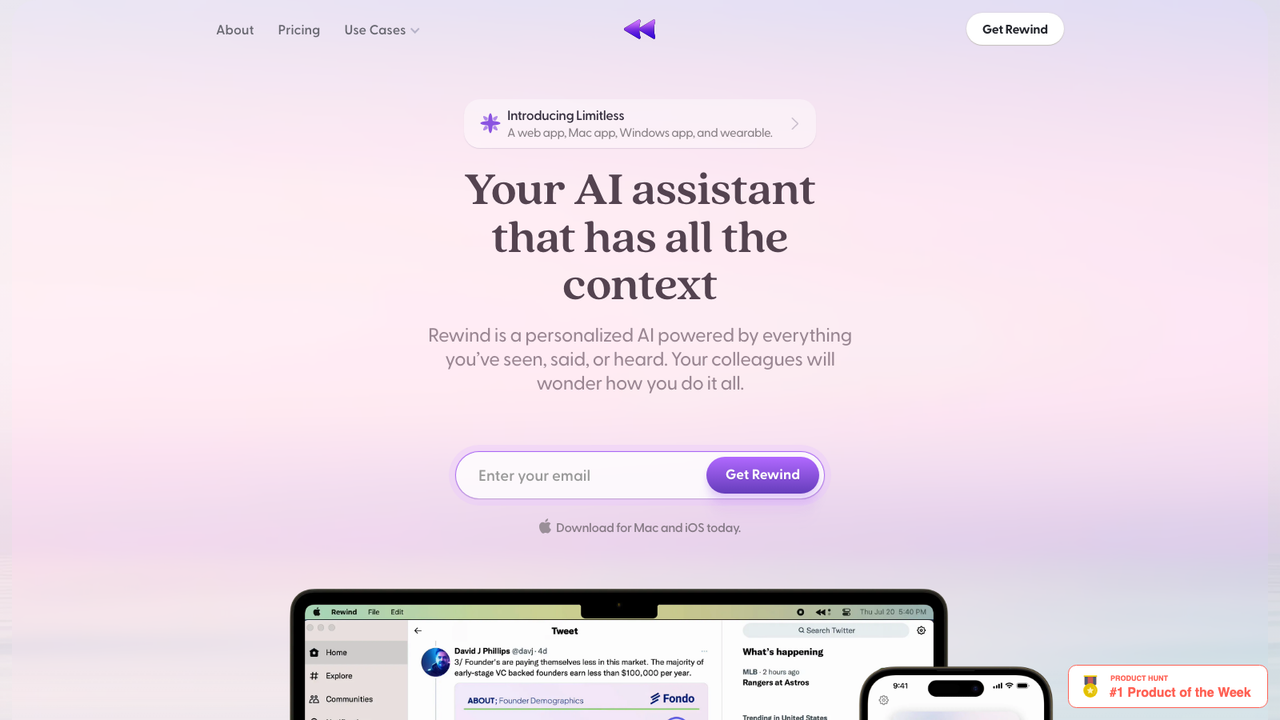
Rewind's homepage on 3 December 2025, two days before the Meta deal was announced. The "Introducing Limitless" banner at the top is the rebrand already in progress. Captured from the Internet Archive snapshot, because this page does not exist anywhere else any more.
In 2024 the company rebranded from Rewind to Limitless and moved to limitless.ai. The focus shifted from the Mac app to the Pendant, a wearable that captured conversations, plus a cloud-based personal AI product around it. The Mac app kept working, but it stopped being the thing the company was about.
On 5 December 2025, CNBC reported that Meta was acquiring Limitless. Limitless CEO Dan Siroker confirmed it in a blog post and a Meta spokesperson confirmed it separately. Terms were not disclosed. The team went into Reality Labs, the division that already owns the Ray-Ban Meta glasses and the VR headsets, which tells you what Meta wanted: not the software, the wearable expertise.
Then on 19 December 2025, two weeks after the deal was announced, recording in the Rewind app was disabled for good and the downloads were removed.
What Meta actually bought
Limitless had raised over $33 million from a16z, NEA, First Round Capital and Sam Altman. Pendant sales stopped immediately when the deal closed. Siroker said existing Pendant customers would be supported for at least another year, which is a more graceful wind-down than most acquisitions manage, but it is still a wind-down with a date on it.
The strategic logic is not hard to read. Meta has been talking about "personal superintelligence", meaning AI that has continuous context on your life rather than AI that answers questions when you open a chat box. A pendant that passively records your day is a direct route to that, and buying a team that has already shipped one twice is faster than building it.
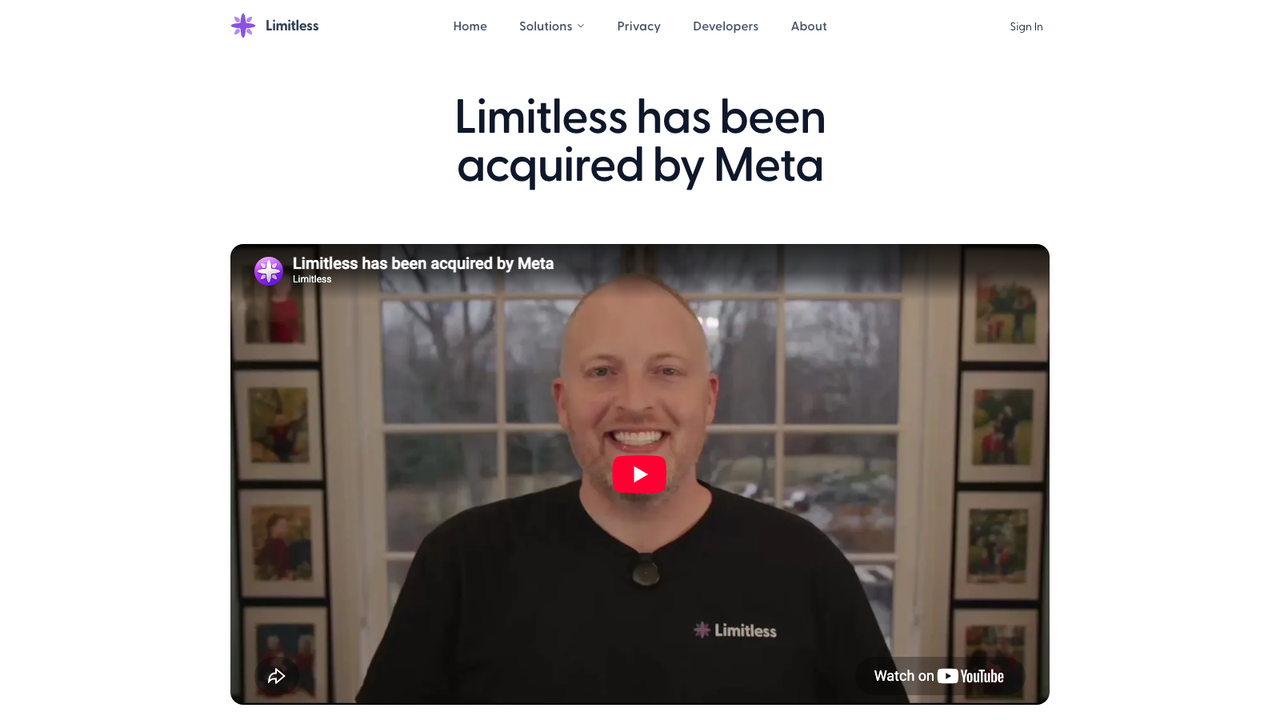
limitless.ai today. Siroker announced it himself, wearing the Pendant, which is the part Meta actually wanted.
What that means for anyone who was using the products is simple and slightly brutal: the acquisition was about the hardware team, and the standalone software was never going to survive it.
The part that confuses everyone
Here is where it gets strange. The rewind.ai domain is now an independent AI tools platform. Not a redirect, not a parked page, not a farewell notice. A functioning site with its own product and its own prices.
To their credit, whoever runs it now has published a page about exactly this. In their own words:
This site is an independent free AI tools platform with no affiliation to the original Rewind AI, Limitless, or Meta.
They also lay out the timeline honestly, including the line "Recording in the Rewind app is disabled for good and downloads are removed" against 19 December 2025. I have no complaint about how they have handled it. They are being clearer than most companies are about their own shutdowns.
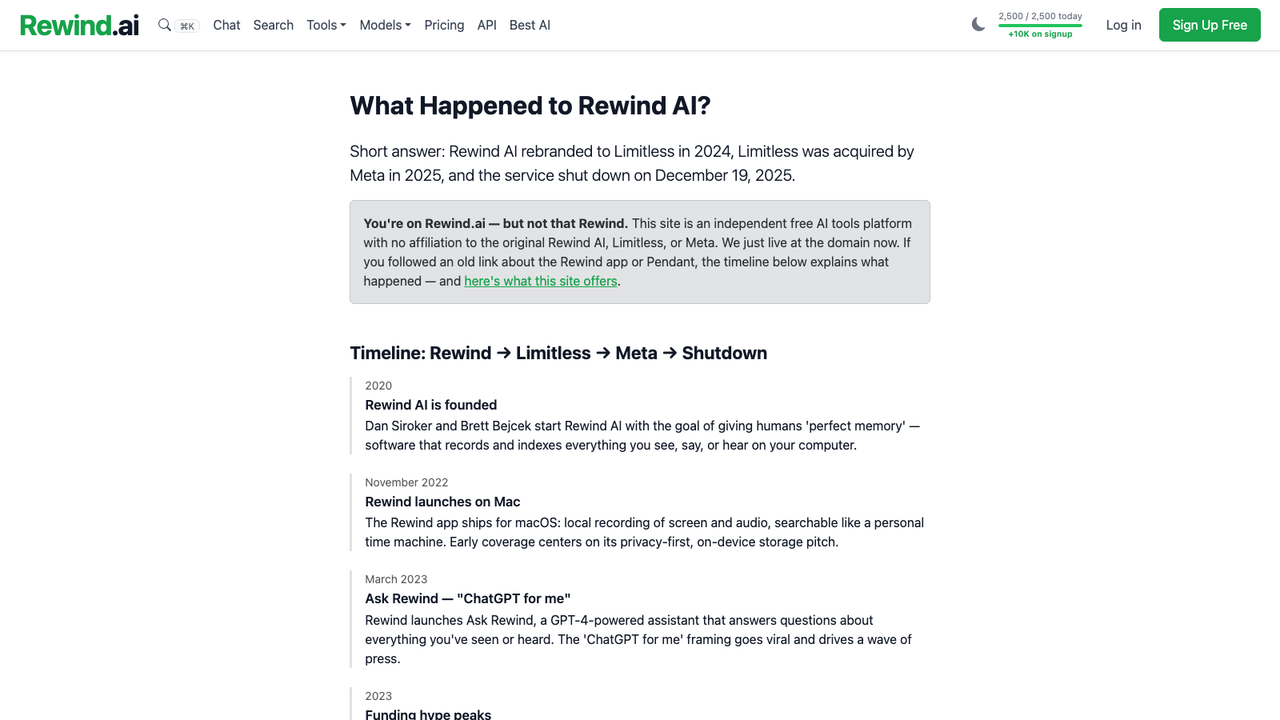
The disclosure page at rewind.ai. Note the nav bar: Chat, Search, Tools, Models, Pricing, API. None of that is Rewind.
But the practical effect is that the top result for a product search leads to a live commercial site that is not the product. If you were half paying attention, you would enter your card details for a subscription to something you were not looking for.
How my own database got this wrong
This is the part I would rather not write, but it is the most useful thing in the post.
I have a crawler that reads vendor pricing pages and stores what it finds. It visits each tool's URL, clicks the monthly billing toggle, and records the tier ladder. It ran across the whole directory and it worked well, which is the problem, because it visited rewind.ai on 29 August and did its job perfectly. It came back with four tiers: Free, Basic at $5, Pro at $19, Business at $49.
Those are real prices. They are just somebody else's prices.
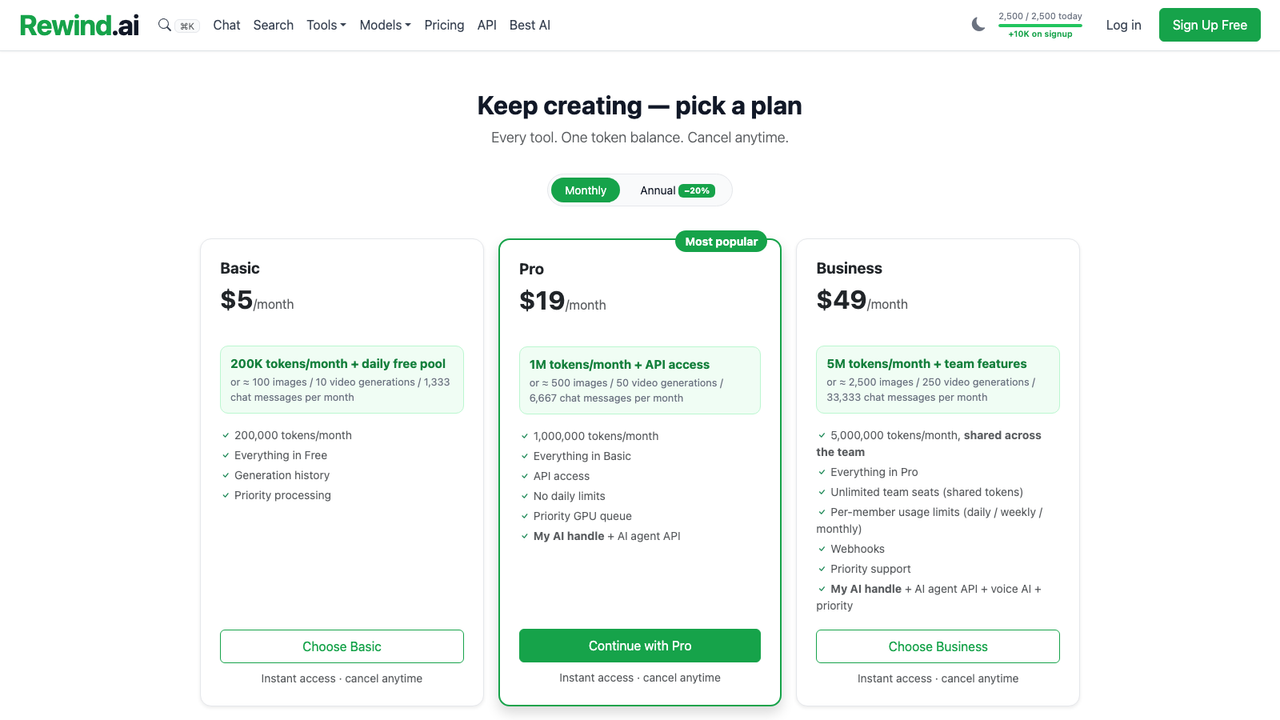
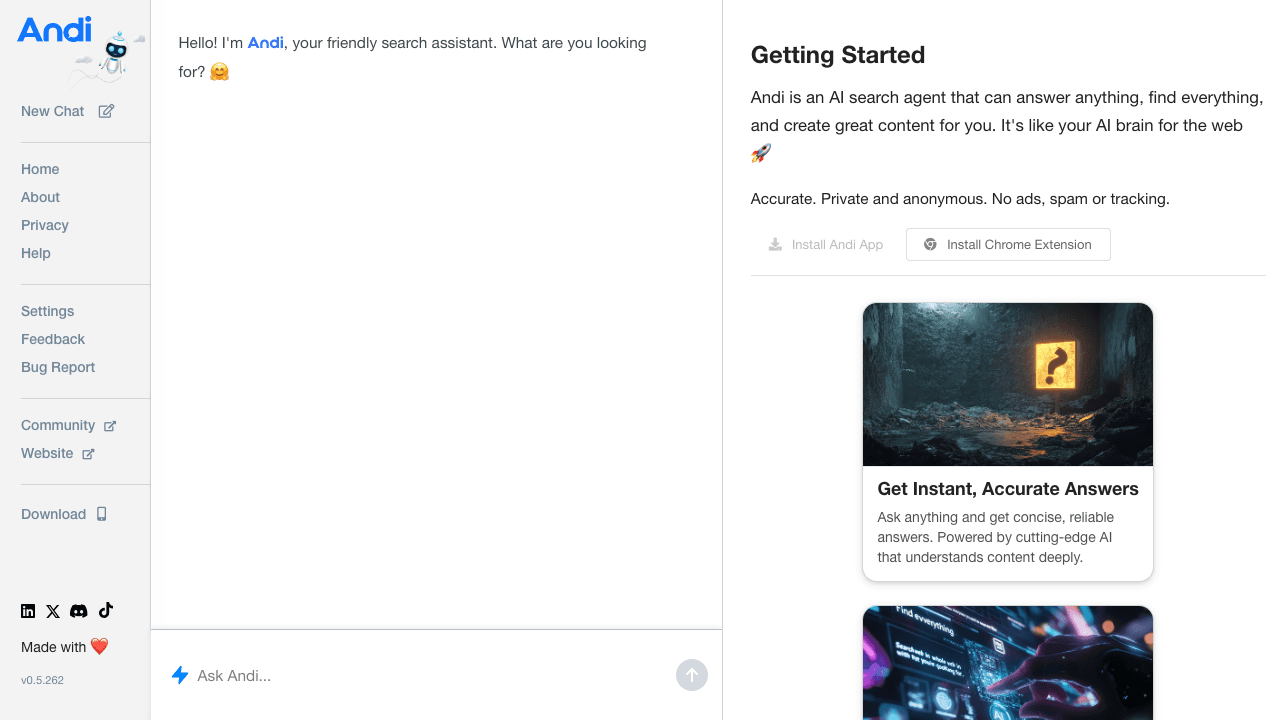
The page my crawler read. It is a completely legitimate pricing page, with a monthly billing toggle my script dutifully clicked, for a token-based AI tools platform that has nothing to do with a Mac screen recorder.
So my listing for Rewind ended up pairing a description of a discontinued Mac screen-recorder with a completely unrelated company's price list, and presenting the combination as a fact about a product that no longer exists. As I write this the row still carries price_from 0 and price_to 49 from that crawl, and I am fixing it today.
The failure mode is worth naming because it is not specific to me. Any automated data pipeline keyed on a domain assumes the domain still means what it meant. A crawler cannot tell the difference between a company changing its prices and a company ceasing to exist while somebody else takes the URL. It sees HTTP 200 and structured pricing and reports success. The check that catches this is not a better parser, it is asking whether the product on the page is still the product in your database, and that is a question you have to remember to ask.
I found it because I was auditing listings for stale content, not because anything alerted me. That is not a system I am proud of. It is on the list.
What you actually lose
The specific thing Rewind did well was continuous local capture of everything on screen, searchable after the fact, without shipping your day to a server. Nothing I can point you at replaces that exactly, and I would rather say so than pretend one of these is a drop-in.
For developers, Pieces for Developers is the nearest thing in spirit. It keeps long-term context about what you have been working on, runs its models locally if you want, and is built around recall rather than chat. It is scoped to your development work rather than your whole screen, which is narrower, but it is the closest thing to the original idea that is still being actively built.
If what you actually valued was the meeting recall rather than the screen history, Granola is the better answer. It captures meeting audio and produces notes you can search later, and it does the one job properly instead of doing everything approximately.
For the searchable knowledge base half of the pitch, Mem and MemoryLake both index what you feed them and answer questions against it, and Notion AI does the same if your notes already live in Notion. None of them capture anything automatically, which is the whole difference. Rewind's trick was that you did not have to decide in advance that something was worth keeping.
Meta will presumably ship something in this space eventually, given what it just bought. Whether you want continuous ambient capture of your life going to Meta specifically is a question you can answer for yourself.
What I take from this one
I have now written three of these. Phind shut down 37 days after raising $10 million. Codeium became Windsurf and then Devin Desktop after Cognition bought it. Rewind became Limitless and then became a line item in Reality Labs.
The pattern in all three is that the product did not fail. Rewind worked, people liked it, and it still got wound down, because the thing being bought was the team and the hardware and the software was overhead. An acquisition is not validation for you as a user. It is often the opposite, and the announcement is the point at which to start planning your exit rather than the point at which to relax.
The local-first thing deserves a note too, because I would have told you Rewind was the safe bet on that basis. Your data was on your own disk. It did not matter. The recording stopped anyway, because the software that reads the data stopped being shipped. Local storage protects you from a server going away. It does not protect you from the client going away, and if the format is proprietary the distinction is thinner than it looks.
So the boring advice stands: if a tool holds something you would miss, check today whether you can get it out in a format that something else can read, and check it while the vendor is still healthy enough to care. And if you are running any kind of automated pipeline over other people's websites, put a periodic "is this still the same product" check in it, because I did not, and it quietly published a dead company's page with a stranger's prices on it for two days.