

You pay for a notes app so you can stop thinking about where things go. Mem sold that for years: $12 a month, unlimited notes, toss it all in. That plan is gone. Mem AI pricing now runs from $9 to $199 a month, and every plan, free included, counts how many new notes you write.
I read every figure in this post on get.mem.ai/pricing on 9 November 2026. I have not used Mem since the change, so this covers what you pay and what each plan allows, not how well the agent behaves.

The homepage tells you why the pricing changed. Mem no longer calls itself a notes app. It calls itself "your AI chief of staff", and the notes are the memory for Mem Agent, which reads them, tracks your tasks and projects, and nudges you. Mem has not said why it changed the pricing. My guess: an agent that reads every note costs money per note, so Mem now meters the notes.
Mem AI pricing, plan by plan
The pricing page shows four plans up front and hides three more behind a "See every plan and allowance" button. The page shows monthly prices only. I found no annual toggle.
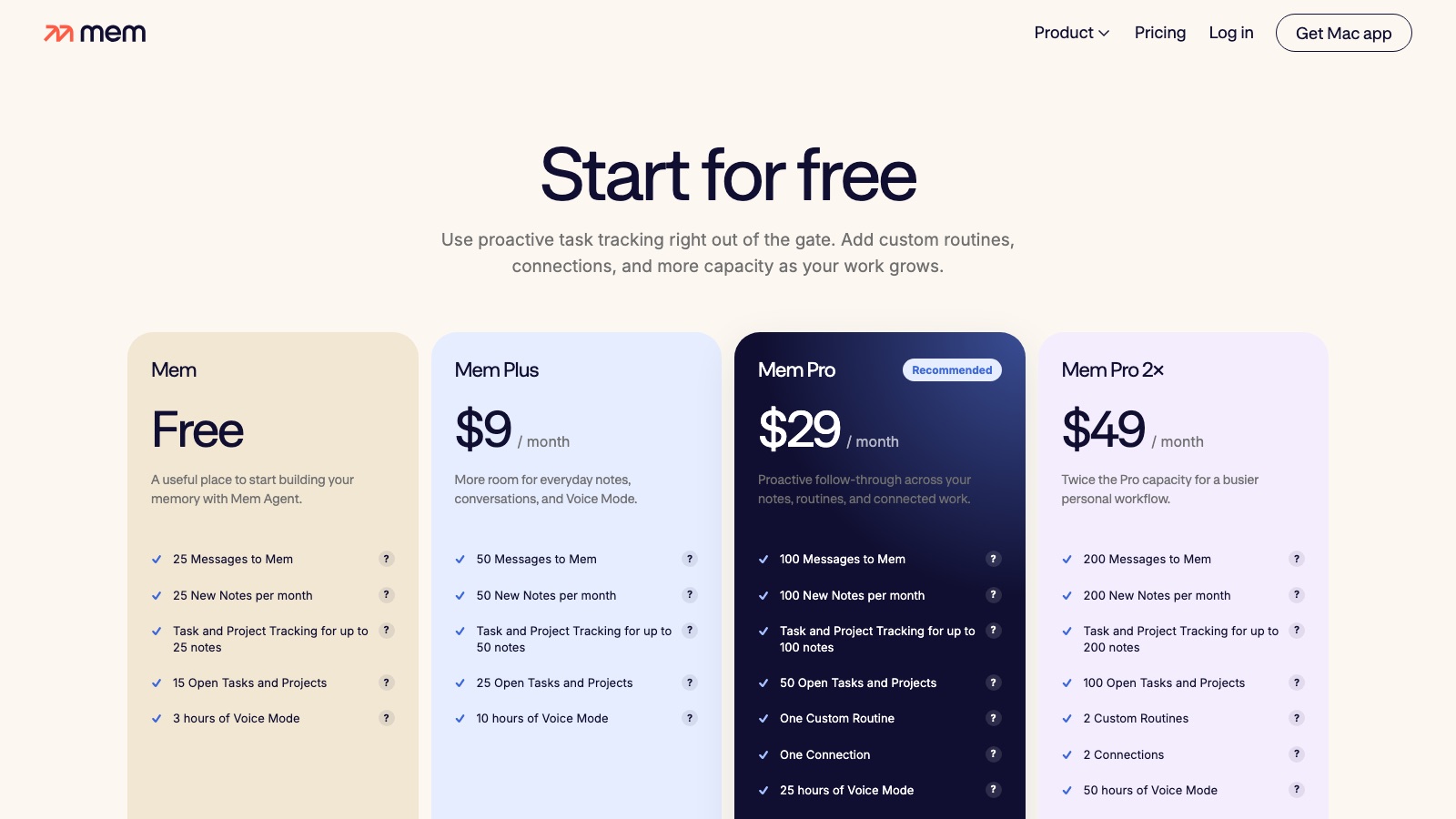
Each plan sets the same allowance for messages and new notes, so one number tells you most of the story. I divided the price by that number to get a cost per new note, which is the figure I would compare before picking a plan.
| Plan | Price a month | New notes and messages | Cost per new note | Routines / connections |
|---|---|---|---|---|
| Free | $0 | 25 | - | none |
| Mem Plus | $9 | 50 | 18 cents | none |
| Mem Pro | $29 | 100 | 29 cents | 1 / 1 |
| Mem Pro 2x | $49 | 200 | 24.5 cents | 2 / 2 |
| Mem Pro 5x | $99 | 500 | 19.8 cents | 5 / 5 |
| Mem Pro 10x | $149 | 1,000 | 14.9 cents | 10 / 10 |
| Mem Pro 20x | $199 | 2,000 | under 10 cents | 20 / 20 |
Voice Mode scales the same way: 3 hours on Free, 10 on Plus, 25 on Pro and 500 on Pro 20x. Open tasks and projects that Mem tracks at once run from 15 on Free to 1,000 on Pro 20x.
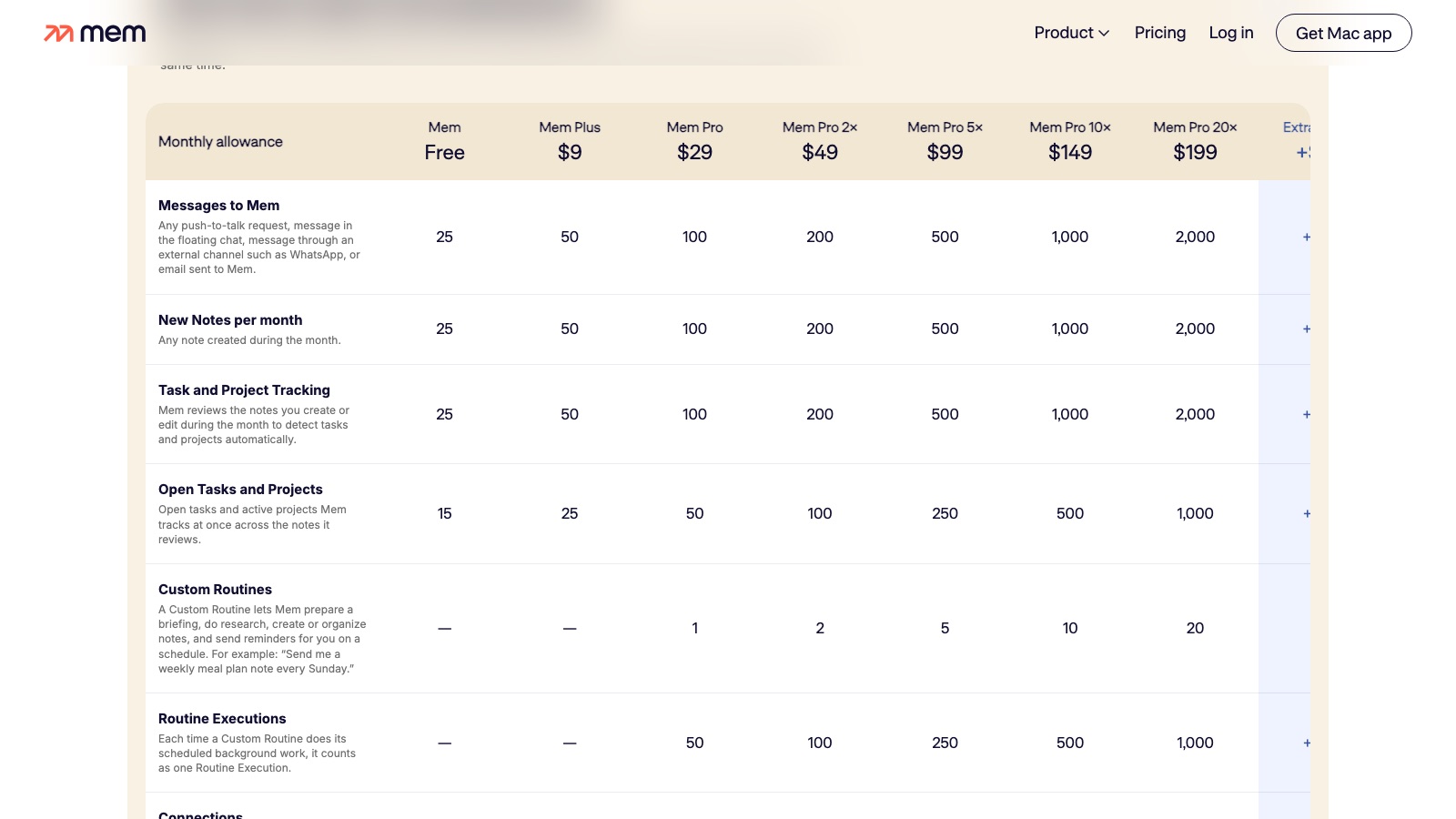
If you outgrow Pro 20x, Mem sells Extra Usage blocks at $50 a month. Each block adds 500 messages, 500 new notes and 125 Voice Mode hours. The FAQ says only Pro 20x customers can buy them, so on every other plan the only answer to a full month is a bigger plan.
The $12 plan is now $29, with limits
Until late August, Mem had three plans: Free, Mem Pro at $12 a month with unlimited notes and chat, and Mem Proactive at $99 a month with the agent. UsagePricing, a site that snapshots vendor pricing pages, logged the switch to the seven-plan ladder on 25 August 2026. Their capture from 29 July still shows the $12 plan.
If you were on the old Pro, you have two choices. Stay on the plan called Pro and pay $29, which is 2.4 times what you paid, for 100 new notes a month. Or drop to Plus at $9, pay less than before, and live with 50 notes and 50 messages a month. Neither one gives you back "unlimited".
The old $99 price point still exists, but it buys a different thing. Proactive was the agent tier. Now $99 buys Pro 5x: 500 notes and 500 messages, five routines and five connections.
Everything you send counts
The caps would not matter much if they counted only big notes. They count everything. The FAQ says any note created during the month counts as a new note. An email you forward to Mem counts as a message, and if it creates a note, it counts as a note too. A push-to-talk request counts as a message. So does a WhatsApp message to Mem.
That changes how you use it. The old pitch, and the one testimonial still on the pricing page, says "I toss it in Mem and know it will be there when I need it." On Plus, 50 tosses a month works out to fewer than two a day. If you clip articles, forward receipts and dictate thoughts, 50 goes fast.
The page does not say what happens to notes you already have. The limits name new notes and the notes Mem reviews in the month, so your archive should stay where it is, but the pricing page does not confirm it, so check before you downgrade. Mem says it warns you as you approach a limit. Exports are one click, to Markdown.
The Pro plan costs the most per note
Mem marks Pro as "Recommended", and Pro has the worst cost per note on the whole ladder: 29 cents, against 18 cents on Plus and under 10 cents on Pro 20x.
You pay the extra 11 cents a note for the features Plus lacks. Pro is the cheapest plan with a Custom Routine (a scheduled job, such as "send me a weekly meal plan note every Sunday") and a Connection to Gmail, Slack or Todoist. Without a connection, Mem only knows what you type or say into it, which takes most of the "chief of staff" out of the pitch.
If you want a notes app with AI search, Plus is the better buy, as long as 50 notes a month covers you. If you want the agent watching your inbox, Pro is the entry fee, and one connection is a tight limit for anyone who lives in both email and Slack.
Should you stay on Mem?
Stay if the agent is why you are there. Pro is a fair price for one connected inbox and one routine, and the higher plans get cheaper per note as you climb. Deep Search and templates are on every plan, Free included.
Leave, or at least export, if you used Mem as a dump for everything. A capped note count fights that habit, and you will start deciding whether a thought is worth a note, which is the decision Mem used to take away. Your data is encrypted at rest and in transit, but Mem says it is not end-to-end encrypted, because the agent has to read your notes.
If you want to look around, Mem vs Notion AI is the closest swap when your notes already live in Notion. Granola vs Mem fits if meetings are most of what you capture, and Mem vs MemoryLake covers the searchable-archive side. If you came to Mem after Rewind shut down, what happened to Rewind AI covers the other tools people moved to.