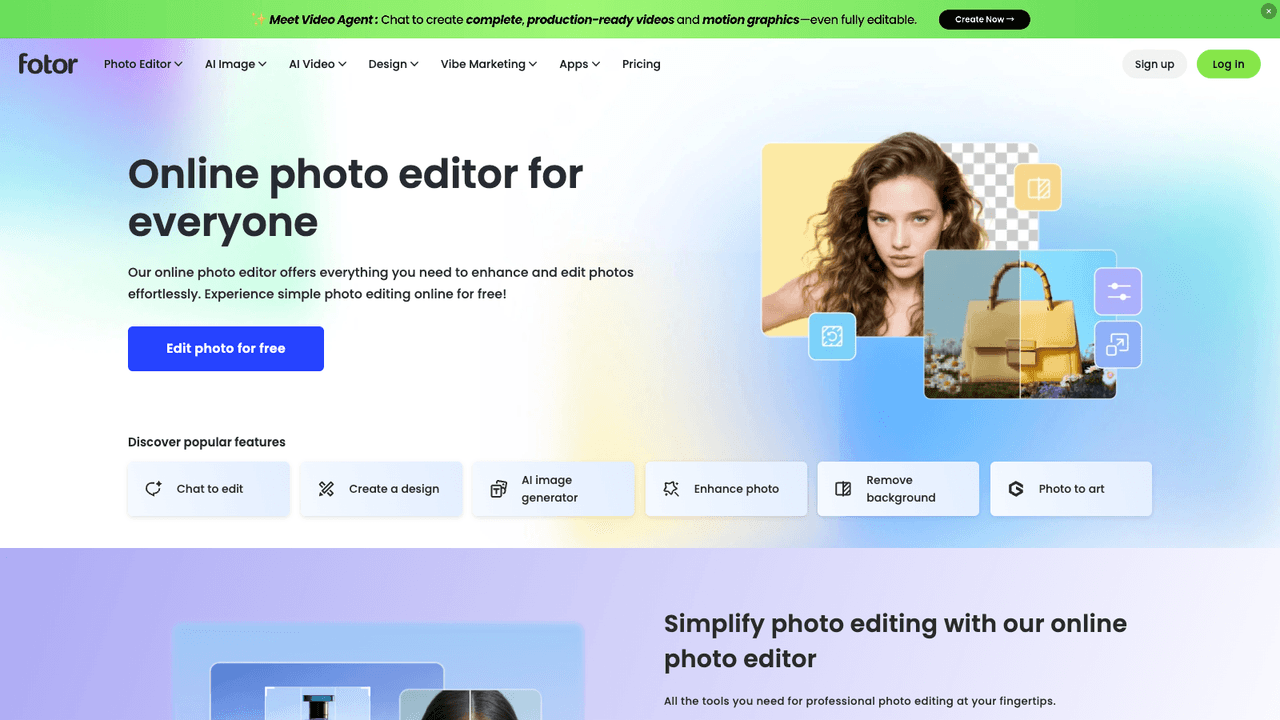
Disclosure first, because it changes how you should read everything below. Fotor gave me 3,000 credits free to test Fotor Video Agent, and I am in their affiliate programme, so the links to Fotor in this post earn a commission if you subscribe through them. They did not see this post before it went up, they have no approval over it, and nothing here was written to their brief. But I did not pay for what I am reviewing, and you should weigh that.
What I can give you that a press release cannot is the arithmetic. I made three finished videos: a product commercial, an animated still, and an explainer fronted by an AI presenter. They cost 949 credits between them, and I have the balance to prove it. That is a real number, and it converts directly into what this would cost you.
What I made
The first is a commercial for this site. A browser frame, the tools grid, the count badge animating in. It is the kind of thing I would previously have either paid someone for or not bothered with, which in practice always meant not bothering.
The second is different work. I started from a single photograph of a cyclist on a street and animated it, with a stylised treatment that reduces the rider to a white silhouette and traces the bike in yellow. The hand lettering reads "cycling is therapy".
The third is an explainer with an AI presenter and AI narration. No camera, no studio, no presenter to book, and no recording day.
I am showing you all three rather than describing them because a review of a video tool that contains no video is asking you to take its word for something you could just watch. Judge the output yourself. If you think any of it looks cheap, that is a legitimate conclusion and you now have the evidence to reach it without me.
The presenter is the one I expected to be disappointed by, and I was not. Quality is fine. Expression and lip sync hold together at normal viewing size, the background has depth rather than looking pasted in, and the narration carries a full sentence without the flat cadence that usually gives synthetic voice away. It is not going to win anything, but it comfortably clears the bar for an explainer nobody is going to study frame by frame.
Where it saves real time is the production overhead, not the edit. A talking-head explainer normally means writing a script, booking someone, finding a location or a background that does not embarrass you, filming, and only then cutting it. This collapses all of that into writing the script. For a marketing team shipping a product update, a feature walkthrough, or the same explainer again in a second language, that is days out of the process rather than hours. If I were going to use Video Agent commercially, this is the job I would use it for.
The interface is the part I did not expect to like
Most AI video tools give you a prompt box and a spinner, and the entire product is the wait. Video Agent does that too, but it also opens into a real editor: a timeline with separate tracks, a project assets panel, and a preview. The AI panel sits on the right with named jobs rather than a blank field, things like Talking Presenter, TVC Film, Product Ads, UGC Creator Ads, Smart Video Montage and Long Video to Shorts.
That framing does more work than it looks like. "Describe your video" is a worse prompt than it sounds, because the model needs to know the shape of the thing, and most people cannot articulate a shape they have not seen. Picking Product Ads and then describing the product gets you somewhere far faster than describing an ad from nothing.
The filter and style selection is genuinely good, and it is where the second video came from. The stylised treatments are specific enough to be a choice rather than a preset, which is the difference between output that looks like everyone else's and output that looks like a decision.
Which models you actually get
This is the part I underrated before looking properly. Fotor is not running its own video model. It is a front end onto other people's, and the list is long enough that I counted it rather than trusting my impression.
On the video side their pricing page lists Seedance 2.5, 2.0, 2.0 Mini and 1.0 Pro, Kling 3.0, 3.0 Turbo, 3.0 Omini, 2.6, 2.5 Turbo, 2.1 and 2.1 Master, Veo 3 and 3.1 plus the Fast variants of both, Wan 2.2 through 2.7, Hailuo 02 and 2.3, PixVerse 4.5, 5.5 and V6, Vidu 2.0 and Q2 Turbo, MiniMax H3, Gemini Omni Flash, Grok and FLUX 3 Video. That is over thirty video models, and the list carries a "View More" link, so it is not even complete.
The image side is the same shape: Seedream 4.0 through 5.0 Pro, GPT Image 1 and 2 across several quality levels, Nano Banana, Nano Banana 2 and Nano Banana Pro, Ideogram v4, FLUX.1 Kontext and FLUX.2 Pro, Midjourney v7, Qwen and Wan.
Two things follow from that, and they point in opposite directions.
The good one: you are not betting on Fotor having built a competitive model, because they have not tried. You are buying a single subscription that reaches Veo, Kling, Seedance and Midjourney without holding four accounts and four bills. For occasional use that is the whole value proposition, and it is a real one.
The less good one: a reseller is only ever a pass-through. If Google reprices Veo, that lands on you eventually. And "Exclusive AI model access" is listed as a paid-tier feature, so the free tier does not reach the full catalogue.
What it actually cost
Here is the part worth your attention, and the answer moves by a factor of nearly four depending on how you pay.
I started with 3,000 credits and finished with 2,051. Three videos, 949 credits, an average of 316 credits each. That includes the presenter piece, which I had assumed would be the expensive one and which evidently was not by much.
Fotor Max carries 12,000 credits a year, or 1,000 a month. Billed monthly that plan is $39.99, which prices a credit at four cents: my three videos would have cost $37.95, about $12.65 each. Billed annually the same plan is $134.32 for the year, which is a little over a cent a credit: the same three videos come to $10.62, or $3.54 each.
The cheaper tiers carry less. Pro is $8.99 a month for 1,200 credits a year, Pro+ $19.99 for 3,600. Note the shape of that: Pro gives you 1,200 credits for a whole year, which is barely more than what I spent in an afternoon. If you intend to make video regularly, the entry tiers are not really aimed at you.
That annual-versus-monthly gap is larger than the usual discount, and at the time of writing there is a 30% promotion on top of it, so anything I quote here is a snapshot rather than a constant.
Credits can also be bought separately from the subscription, in blocks from 200 a month up to 10,000, with bonus credits attached at the larger sizes. Unused credits roll over for up to five months while you stay subscribed, which matters more than it sounds: video work is lumpy, and a plan that zeroes your balance every month would punish exactly the occasional user this suits best.
There is a second limit that is easy to miss and specific to the thing I am reviewing. Alongside credits, the plans cap AI Agent tasks: one on Basic, two on Pro, five on Pro+, ten on Max. Chats with the agent are capped separately, from 50 up to 10,000. Credits are not the only ceiling on how much Video Agent you can use, and the published table does not make clear whether those task limits are concurrent or per period. I did not hit either limit across three videos, so I cannot tell you from experience which it is.
Whether any of this is good depends entirely on your alternative. Against commissioning either video from a freelancer it is not close, at either price. Against not making the video at all, which was my honest previous alternative, it is the difference between having a commercial and not having one.
At roughly 316 credits a video, it is not cheap enough to iterate carelessly either. A wasted generation is a third of a video, so you plan the prompt rather than spraying attempts at it.
The free tier exists and will show you the workflow, but exports are watermarked and it does not reach the full model catalogue, so treat it as evaluation rather than production.
What I did not test
I should be clear about the edges of this, because three videos is a small sample and I want you to know where my evidence runs out.
I did not test it at volume. I do not know whether output quality holds up across fifty generations or whether I got three good rolls. I did not test collaboration, brand consistency across a campaign, or anything involving a team. I did not test the long video to shorts pipeline, the UGC creator ad formats, or batch work, which are the features a marketing team would probably lean on hardest.
I also cannot tell you how it compares head to head with the other tools in this space, because I have not run the same brief through them yet. That comparison is worth doing properly, and doing it properly means paying for the others rather than accepting credits from all of them.
Who this is for
If you make occasional marketing video and currently do not make it because the cost of starting is too high, this clears that bar. A product commercial from a set of screenshots, an animated still from one photograph, an explainer with no camera and no presenter to book, and the output is good enough to publish. That is the case I can vouch for, because it is the case I actually ran.
If you generate video daily, the credit arithmetic matters more than anything I have said about the interface, and you should work it out against your own volume before subscribing. If you need brand-exact output, expect to spend credits getting there.
And if you are a developer wondering whether this replaces a motion designer: no, and it is not trying to. It replaces the video you were never going to make.