Muse Code Guide
Independent, source-traceable reference for Meta's terminal coding agent
About Muse Code Guide
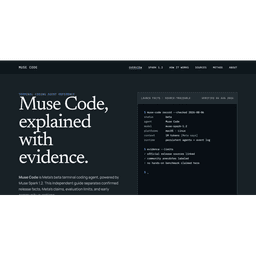
Muse Code Guide is a documentation site rather than a tool, and it exists because of a genuine gap. When a major vendor ships a coding agent, the available information immediately splits into three unlabelled categories: things that are verifiably true, things the vendor has claimed, and things the community has inferred or assumed. Sorting those apart is real work and almost nobody does it. This site does exactly that for Meta's Muse Code, separating confirmed release facts, Meta's own claims, evaluation limits and open community questions, with sources attached.
The editorial discipline is the product. Facts are labelled source-traceable with the date they were verified, currently showing a beta release on 5 August 2026 with evidence reviewed the following day. Evaluation limits are stated explicitly, which matters enormously when reading any vendor's benchmark claims and which vendors themselves never do. A published method section explains how the site decides what counts as confirmed. Content covers the agent itself and the underlying Muse Spark 1.2 model, along with how the runtime works. The site states clearly at the top that it is independent and not affiliated with or endorsed by Meta.
Start with the overview for what Muse Code actually is, then the release record for the source-traceable launch facts with their verification dates. The Spark 1.2 section covers the underlying model, and the how-it-works section explains the runtime. Throughout, claims are categorised rather than presented flat, so you can see at a glance whether something is confirmed, asserted by Meta, or an open question. The sources section provides the underlying references, and the method section documents how the distinction is drawn. Because verification dates are shown, you can judge how current any given claim is rather than assuming.
- •Claims Separated by Status - Confirmed facts, vendor claims, evaluation limits and open questions kept distinct rather than blended
- •Source-Traceable Facts - Every claim tied to a source with a stated verification date
- •Stated Evaluation Limits - Explicit about what benchmarks do and do not show, which vendors never are
- •Published Method - Documents how it decides what counts as confirmed, so the editorial standard is inspectable
- •Runtime Documentation - Covers how the agent actually works, not only what it claims to do
- •Model Coverage - Documents the underlying Muse Spark 1.2 alongside the agent
- •Independence Stated Upfront - Declares plainly that it is not affiliated with or endorsed by Meta
- •Dated Evidence Review - Verification dates shown so staleness is visible
For developers evaluating whether to adopt Meta's Muse Code, who want the verified facts separated from the launch marketing before committing time. It suits engineering leads assessing a new agent for a team, where the difference between a demonstrated capability and a claimed one determines the decision. Anyone comparing terminal coding agents gets a source-traceable baseline for one of them. Note clearly that this is an independent reference site, not Meta's product and not the agent itself.
Pricing
Not published by the vendor
Free to read - an independent reference site with no account, subscription or paywall
From the vendor pricing page, 2026-09-18