

Most months the new AI tools are the same product with a different logo. August had a handful that are actually solving something, and a pattern worth noticing: several of them compete on what they charge you for rather than on features. Per application instead of per log line. Per token instead of per seat. Per hour instead of per user.
Here are ten worth knowing about, grouped by the problem they solve.
Keeping Your Data on Your Own Machines
Dograh
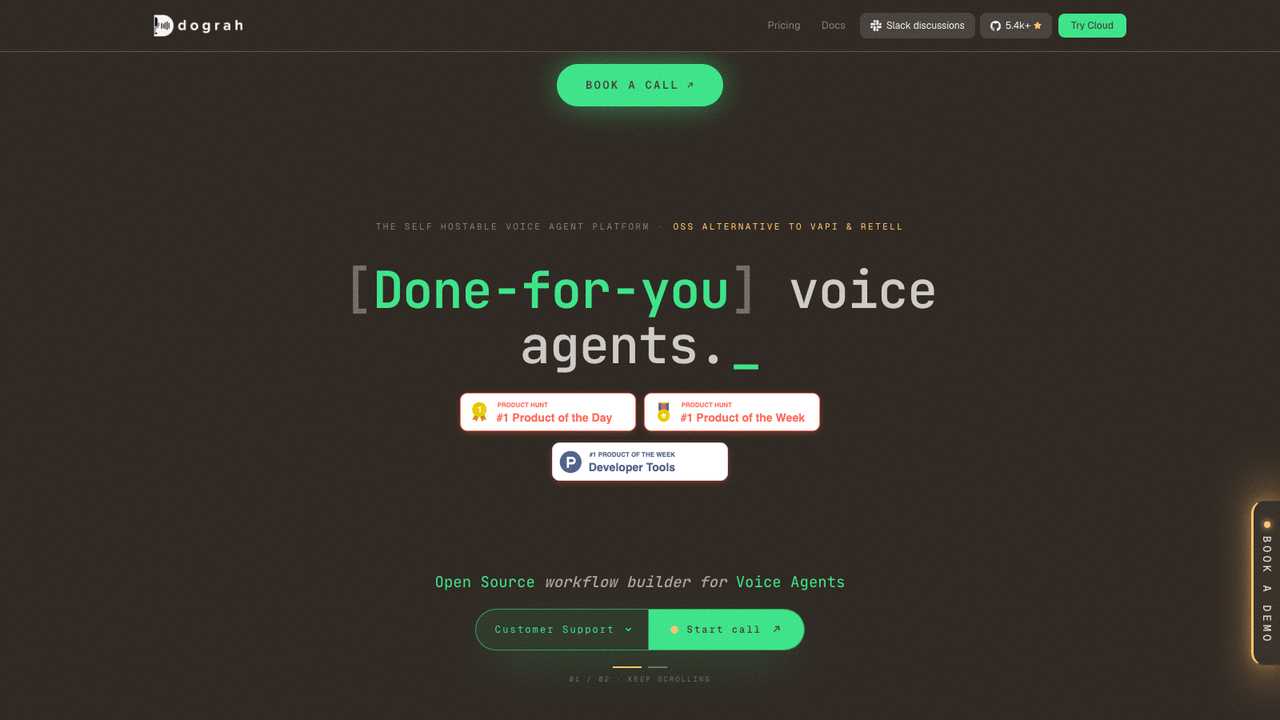
What it is: an open-source voice agent platform you host yourself, positioned as the Vapi alternative.
Voice agents answer phone calls, and in healthcare, finance or legal, those recordings are the most sensitive material a company holds. Every major hosted platform requires shipping all of it to a third party, which is where a lot of these projects quietly die in a compliance review. Dograh runs in your own VPC or on-premises instead.
The stack is modular rather than fixed. Speech-to-text, the language model, text-to-speech and telephony are each swappable, and you can run Whisper or Kokoro locally so no external API is ever called. The clever part is hybrid voice, which mixes pre-recorded human clips with generated speech in the same voice, so scripted sections of a call sound genuinely human and you cannot hear the join. Agents can also be built over MCP from Claude Code or Cursor rather than through a web builder.
Cost: free forever self-hosted under BSD 2-Clause. Managed cloud from $5 in credits. Best for: anyone whose legal team has opinions about where call recordings live.
NobodyWho
What it is: a library for running text, vision and speech models on the device instead of calling an API.
The reach is the unusual part. Most local-inference projects support one runtime; this covers React Native, Flutter, Kotlin, Swift, Python and Godot, so the same approach works for a mobile app, a desktop tool and a game. Models come straight from Hugging Face in GGUF format, with optimised kernels for Metal, CUDA and Vulkan, and it runs on hardware down to a smartwatch.
No API keys and no usage fees also mean inference cost does not grow with your user count, which removes an entire category of scaling problem before it starts.
Cost: free and open source under EUPL 1.2. That licence is copyleft, so read it before building something closed on top. Best for: mobile and game developers who need AI features that work offline.
HyNote
What it is: meeting transcription for Mac that never uploads your audio.
Almost every mainstream notetaker works by sending recordings to a server. That is fine until the meeting covers salaries, an acquisition or a patient. HyNote transcribes locally, which changes what you are allowed to point it at, and works without a connection as a side effect. It handles podcasts and general audio too, and nothing joins your call announcing itself as a bot.
Cost: free tier, or $6.66 a month against cloud notetakers that typically charge twenty to thirty. Local processing is why that price is possible. Best for: anyone in a regulated field, or who dislikes a recording bot appearing in the participant list.
Infrastructure That Stopped Punishing You for Using It
bitdrift
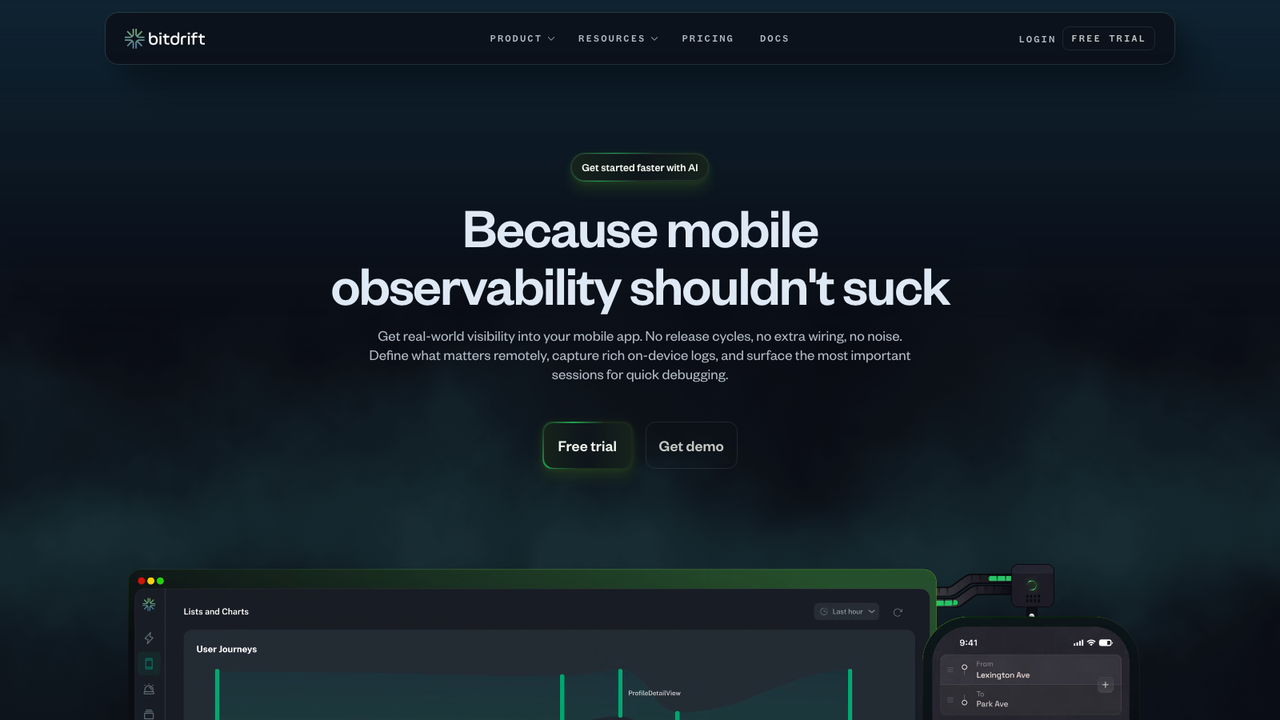
What it is: mobile observability billed per active application rather than per log line.
That sounds like an accounting footnote. It is the entire product. Volume-based logging trains teams to log less, which is exactly backwards, because the log you decided to skip is the one you need when a crash only reproduces on one device model in one country. Mobile makes it worse than anywhere else: you cannot reproduce most crashes, you cannot inspect the user's device, and a fix is days away through app store review.
Remove the volume penalty and instrumentation becomes a question of what is useful rather than what is affordable.
Cost: the free tier covers five users, 100,000 crash reports a month across unlimited devices, 14-day retention and three workflows, which is enough to run a small production app rather than just trial it. Enterprise pricing is contact-only. Best for: mobile teams who have ever deleted logging to control a bill and regretted it during an incident.
MeetStream
What it is: one API for meeting bots across Zoom, Google Meet and Microsoft Teams.
If you are building anything that sits inside meetings, the hard part was never the AI. It is that three platforms have three sets of bot mechanics, three auth flows and three ways to fail, and keeping bots reliably joining all of them is permanent maintenance nobody signed up for.
The detail worth noticing is per-participant audio streams. Each attendee arrives as a separate track rather than one mixed room feed, which is the difference between a transcript that knows who said what and one that guesses. Bots can also post chat messages and display images, so they can take part rather than only listen.
Cost: $0.35 per hour of meeting rather than per seat, starting with $5 of free credit and no card required. Best for: developers building a notetaker, sales coach or compliance recorder who would rather not maintain three integrations.
Code Review, Which Is Now the Real Bottleneck
Generating code got cheap. Reading it did not. Three of the more interesting tools here attack the same bottleneck.
Greptile
Reviews pull requests with your whole repository indexed, not just the diff. That matters because the expensive bugs come from code that is perfectly correct in isolation and wrong given something three files away, and a tool reading only the patch cannot see them.
Cost: free tier, then $30 per seat per month including 50 credits, with extra credits at $1 each.
CodeRabbit
The most widely deployed reviewer of the three, which is a genuine advantage for something you embed this deeply in your pipeline. It raised $143M and now describes itself as the control layer for software change, which is a fair read of where review sits once agents write a large share of the diffs.
Cost: real free tier, per-user plans from $24 a month billed annually, plus agent time at $0.50 a minute so occasional deep analysis does not mean paying for the top plan year-round.
Optibot
Pairs review with engineering analytics, so the review pass doubles as your measurement. If you have ever been asked why delivery slowed down and had only anecdotes to offer, that is the pitch.
Cost: $29 per user per month for 50 deep reviews, $49 for 100, billed annually.
Choosing between them: run all three free tiers against the same repository for a week and read the comments. Feature lists in this category have converged; comment quality on your own code has not. The question that actually predicts success is whether your engineers are still reading the bot in week three.
Two That Are Simply Good
Zed
What it is: a code editor written in Rust by the team behind Atom, built on the argument that editor latency is a correctness problem rather than a comfort one. An editor that stalls while you type breaks the loop where you are holding a problem in your head.
The AI pricing is the interesting departure. Most AI editors charge a flat fee for an assistant with limits nobody publishes. Zed includes $5 of tokens on the $10 Pro plan and meters usage beyond that, so light users stop subsidising heavy ones and heavy users stop hitting invisible walls. Multiplayer editing is native, which makes pairing a shared buffer rather than a screen share.
Cost: the free tier is the complete editor. Pro is $10 a month, teams $30 per seat. Best for: anyone who has felt a heavier editor get in the way on a large codebase.
AdAnt

What it is: social video ads generated through a creative agent you brief in chat.
The distinction it draws is between AI video, which makes something pretty that nobody clicks, and advertising, which has a job to do. The unit of work is an ad concept and the loop is variations against a single brief, which is how performance creative actually gets made: not one perfect video but a dozen attempts until one earns its place in the feed.
Cost: 50 free credits on signup, stated as worth $20, so you can judge the output before paying. Plans from $32.50 a month. Best for: anyone running paid social where creative fatigue means you always need more variations.