
The ai-agents category on this site now has 79 tools. Twelve of them solve problems I can name, and the rest solve problems I have to invent.
If you want the short answer: LangGraph for production agent workflows, CrewAI for the fastest path to a working multi-agent system, Multica for orchestrating coding agents you already have, and OpenClaw or Cline if you want a local agent that runs on your own keys. Everything else in this post is a supporting pick or an honest "skip this one."
Prices were checked against vendor sites in October 2026 and carry a date. I use Multica on this site. The rest of the picks are based on docs, GitHub activity and pricing data, not hands-on testing, and I will say so where it matters.
How I picked
Four criteria, in order:
- What it is built for. A framework that models agent runs as a graph is a different tool from a framework that models them as a chat. The category matters more than the feature list.
- Verified price. Every figure in the tables below comes from the vendor's own pricing page, read in October 2026. If the page showed a different currency or rendered client-side without a figure, I noted it.
- Open source and maintenance. For the open source tools, I checked the GitHub last-pushed date. A project not touched in 12 months is called out.
- Setup effort. A framework you can pip-install and run in an afternoon ranks higher than one that needs a cluster.
What I did not verify: benchmark scores, claimed user counts, testimonials. Those are marketing. The prices and the commit dates are not.
Production agent workflows: LangGraph
The pick: LangGraph
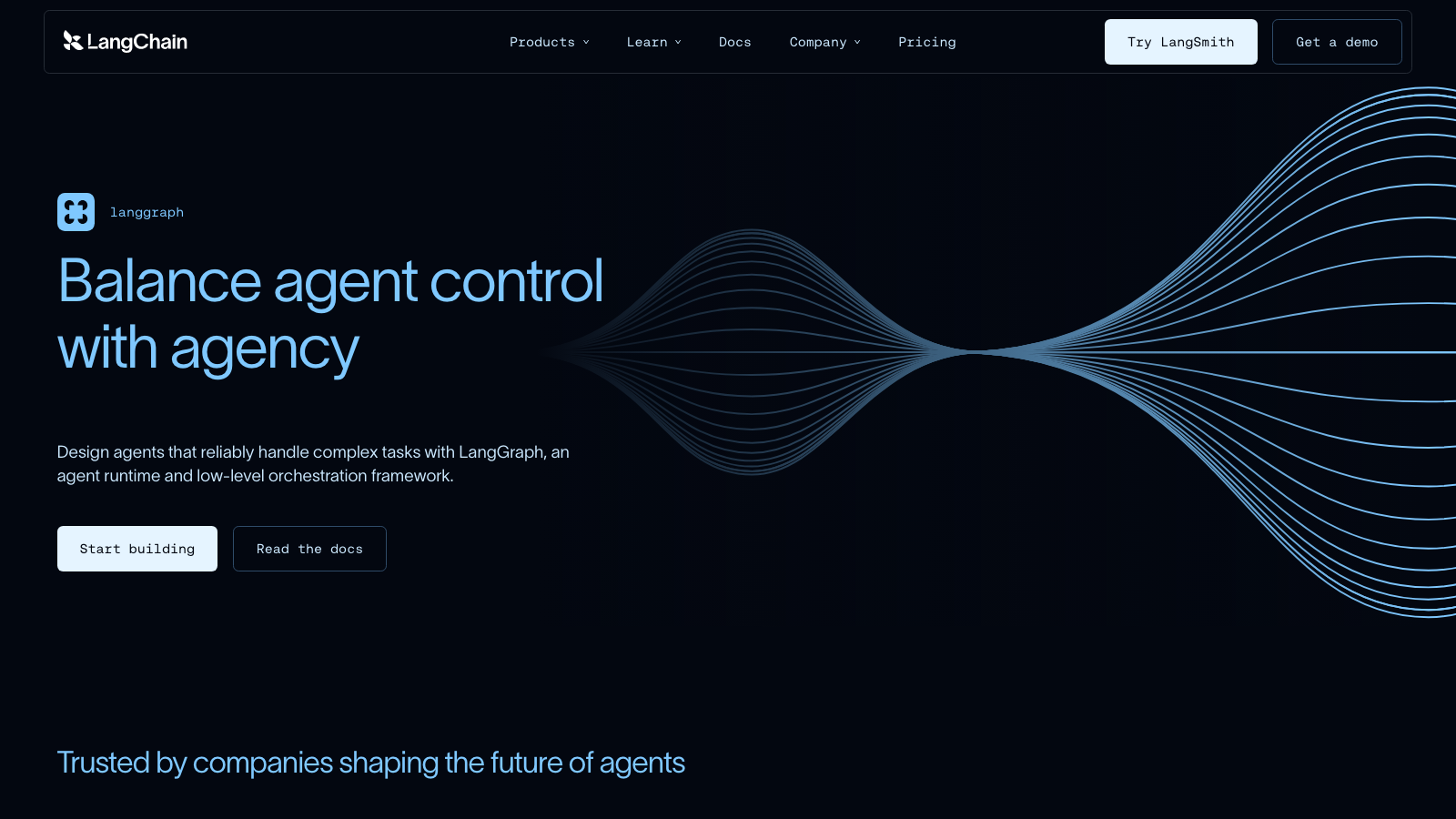
LangGraph models an agent run as a state graph. Nodes are steps, edges are transitions, and the framework handles persistence, retries and human-in-the-loop breaks. You can inspect a run, resume it from a checkpoint, and reason about what went wrong when it fails.
That is what "production" means in this context: not speed, but controllability. A chat-based agent that loops until it decides to stop is fine for demos. An agent that can pause, wait for approval, resume from where it stopped, and leave an audit trail is what you need for anything with consequences.
The framework is open source. LangSmith, the hosted observability and deployment layer, starts free on Developer and goes to $39/month on Plus (checked 18 September 2026).
Runner-up: Mastra. An Apache 2.0 TypeScript framework with typed agents, workflows and built-in observability. Mastra Cloud Starter is free with 100K observability events; Teams is $250/month (checked 16 September 2026). Choose Mastra if your stack is TypeScript end to end.
| Tool | Best for | Open source | Free tier | Entry price | Checked |
|---|---|---|---|---|---|
| LangGraph | Production workflows, state persistence | Yes | Yes (Developer) | $39/mo (Plus) | Sep 2026 |
| Mastra | TypeScript agent stacks | Yes (Apache 2.0) | Yes (Starter) | $250/mo (Teams) | Sep 2026 |
Multi-agent teams: CrewAI
The pick: CrewAI
CrewAI is the fastest way to get multiple agents working together. You define agents by role, give them tools, describe tasks, and let the framework handle the coordination. The mental model is a team staffed for a job, which is easier to reason about than a graph.
The trade-off is control. CrewAI handles the orchestration for you, which means you accept its decisions about who runs when. For demos, prototypes and internal tools, that is a good trade. For anything where you need to explain why step 3 happened before step 4, you want the explicit graph that LangGraph gives you.
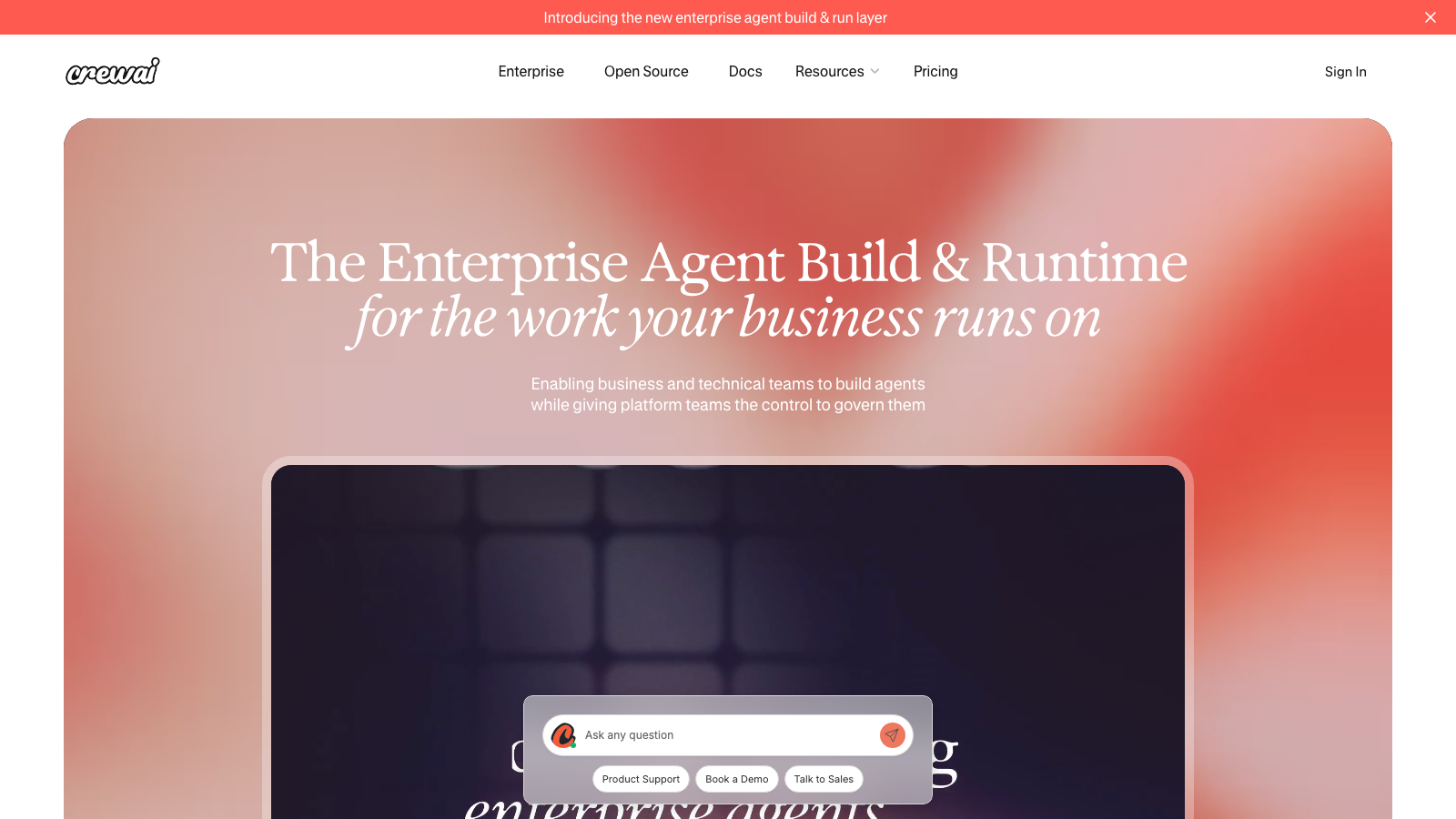
The open source framework is free. Enterprise is contact-only (checked 18 September 2026).
Runner-up: CopilotKit. A framework for embedding an agent in your own application UI, connecting one agent to React, Slack and Teams. Free tier available; Pro is $39/month, Team is $100/seat/month (checked 21 September 2026). Choose CopilotKit if you are building an agent into a product, not running one standalone.
| Tool | Best for | Open source | Free tier | Entry price | Checked |
|---|---|---|---|---|---|
| CrewAI | Fast multi-agent prototypes | Yes | Yes (Basic) | Contact (Enterprise) | Sep 2026 |
| CopilotKit | Agent UI in your app | Yes | Yes (Developer) | $39/mo (Pro) | Sep 2026 |
Coding agents: Cline or OpenCode
The pick: Cline or OpenCode, depending on whether you want a subscription or usage billing.
Both are open source coding agents that run on your own API keys. No subscription, no seat fee. You pay the inference provider for the tokens you burn.
Cline is Apache 2.0 and runs inside VS Code. OpenCode is MIT and runs in the terminal, editor or as a desktop app with 75+ model providers. Cline is client-side, so requests go direct to the provider. OpenCode auto-loads language servers so the model reads real type errors.
The honest comparison: if you reach for an agent a few times a day, usage billing is cheaper. If you live in an agent terminal all day, a $20 subscription plan beats usage. Neither wins in every case.
Runner-up: Devin AI. Autonomous coding agent from Cognition that plans, writes and debugs across a repo. Free tier available; Pro is $20/month, Max is $200/month (checked 18 September 2026). Choose Devin if you want a hosted service rather than managing your own keys.
| Tool | Best for | Open source | Free tier | Entry price | Checked |
|---|---|---|---|---|---|
| Cline | VS Code, usage billing | Yes (Apache 2.0) | Yes (BYOK) | Inference only | Sep 2026 |
| OpenCode | Terminal, multi-provider | Yes (MIT) | Yes (BYOK) | Inference only | Sep 2026 |
| Devin AI | Hosted autonomous coding | No | Yes | $20/mo (Pro) | Sep 2026 |
Browser agents: Browser Use
The pick: Browser Use
An MIT-licensed Python library that lets an LLM drive a real browser. The hosted platform runs the same agent on managed cloud sessions.
Browser automation is the use case that separates agents from chatbots. A chatbot can tell you how to fill a form. A browser agent fills the form. Browser Use is the tool I would reach for if I needed to automate something that has no API.
The library is MIT and free to self-host. The platform has a free tier (10 tasks/month, no card); paid plans are Dev $29/month, Business $299/month, Scaleup $999/month, each granting that amount as monthly credits with usage metered on top (checked 19 September 2026).
Runner-up: None in this category that I can recommend. Anchor is managed browser infrastructure for computer-use agents, but it is infrastructure, not an agent.
| Tool | Best for | Open source | Free tier | Entry price | Checked |
|---|---|---|---|---|---|
| Browser Use | Browser automation with LLM | Yes (MIT) | Yes (10 tasks/mo) | $29/mo (Dev) | Sep 2026 |
Agent orchestration: Multica
The pick: Multica
Multica is the tool I use on this site. It assigns tasks to coding agents the way you would to people, tracks progress on a kanban board, and gives you a human gate at every step.
The value is coordination, not the agents. Three agents in three terminals produce three disconnected outputs. Three agents on a Multica board produce a backlog with history, comments and attached work. When something goes wrong, the record is on the issue, not in scrollback you closed.
Self-hosting is free with no caps on agent count. Cloud pricing is not published (multica.ai/pricing returns 404 as of September 2026). The licence is Apache 2.0 with additional conditions: you cannot offer Multica as a hosted service to third parties without a commercial licence.
For more on the setup and what a few hours of use consumed, see I Gave My Coding Agents a Task Board.
Runner-up: Orca. MIT-licensed desktop app that runs Claude Code, Codex and other coding agents in parallel, each in its own git worktree. Free; Enterprise is contact-only (checked 18 September 2026). Choose Orca if you want parallel worktrees without a board.
| Tool | Best for | Open source | Free tier | Entry price | Checked |
|---|---|---|---|---|---|
| Multica | Task board for agents | Source-available | Yes (self-host) | Not published | Sep 2026 |
| Orca | Parallel worktrees | Yes (MIT) | Yes | Contact (Enterprise) | Sep 2026 |
Memory and context: Mem0
The pick: Mem0
An Apache 2.0 memory layer for AI agents. Send it conversation turns, it extracts the facts worth keeping, and your agent recalls them in later sessions.
Memory is the part most agent demos skip. A demo runs once, so it does not need to remember anything. A production agent runs over days and needs to know what it learned yesterday. Mem0 is the cleanest solution I have seen for that problem.
Hobby is free with 10,000 add requests and 1,000 retrieval requests per month. Starter is $19/month, Pro is $249/month and adds graph memory. The open source core is Apache 2.0 and self-hostable (checked 16 September 2026).
Runner-up: Supermemory. Hosted memory API with files, chats and URLs going through a memory model into a per-user graph. Free plan with $5 of credits/month; Pro is $19/month (checked 18 September 2026).
| Tool | Best for | Open source | Free tier | Entry price | Checked |
|---|---|---|---|---|---|
| Mem0 | Long-term agent memory | Yes (Apache 2.0) | Yes (Hobby) | $19/mo (Starter) | Sep 2026 |
| Supermemory | Memory API with graph | Yes | Yes ($5 credits) | $19/mo (Pro) | Sep 2026 |
Observability: Langfuse or Laminar
The pick: Langfuse for self-hosting, Laminar for cloud.
Langfuse is MIT-licensed: tracing, evals, prompt management and datasets, self-hostable via Docker Compose. Hobby is free with 50k units/month; Core is $29/month, Pro is $199/month (checked 16 September 2026).
Laminar is open source agent observability that records what an agent did and surfaces failure modes. Free tier with 1 GB of data and 7-day retention; Starter is $30/month, Pro is $150/month (checked 21 September 2026).
Both solve the same problem: your agent did something wrong, and you need to find out what. The difference is Langfuse is built to self-host and Laminar is built for cloud-first teams.
| Tool | Best for | Open source | Free tier | Entry price | Checked |
|---|---|---|---|---|---|
| Langfuse | Self-hosted tracing | Yes (MIT) | Yes (Hobby) | $29/mo (Core) | Sep 2026 |
| Laminar | Cloud observability | Yes | Yes (1 GB) | $30/mo (Starter) | Sep 2026 |
Local-first: OpenClaw
The pick: OpenClaw
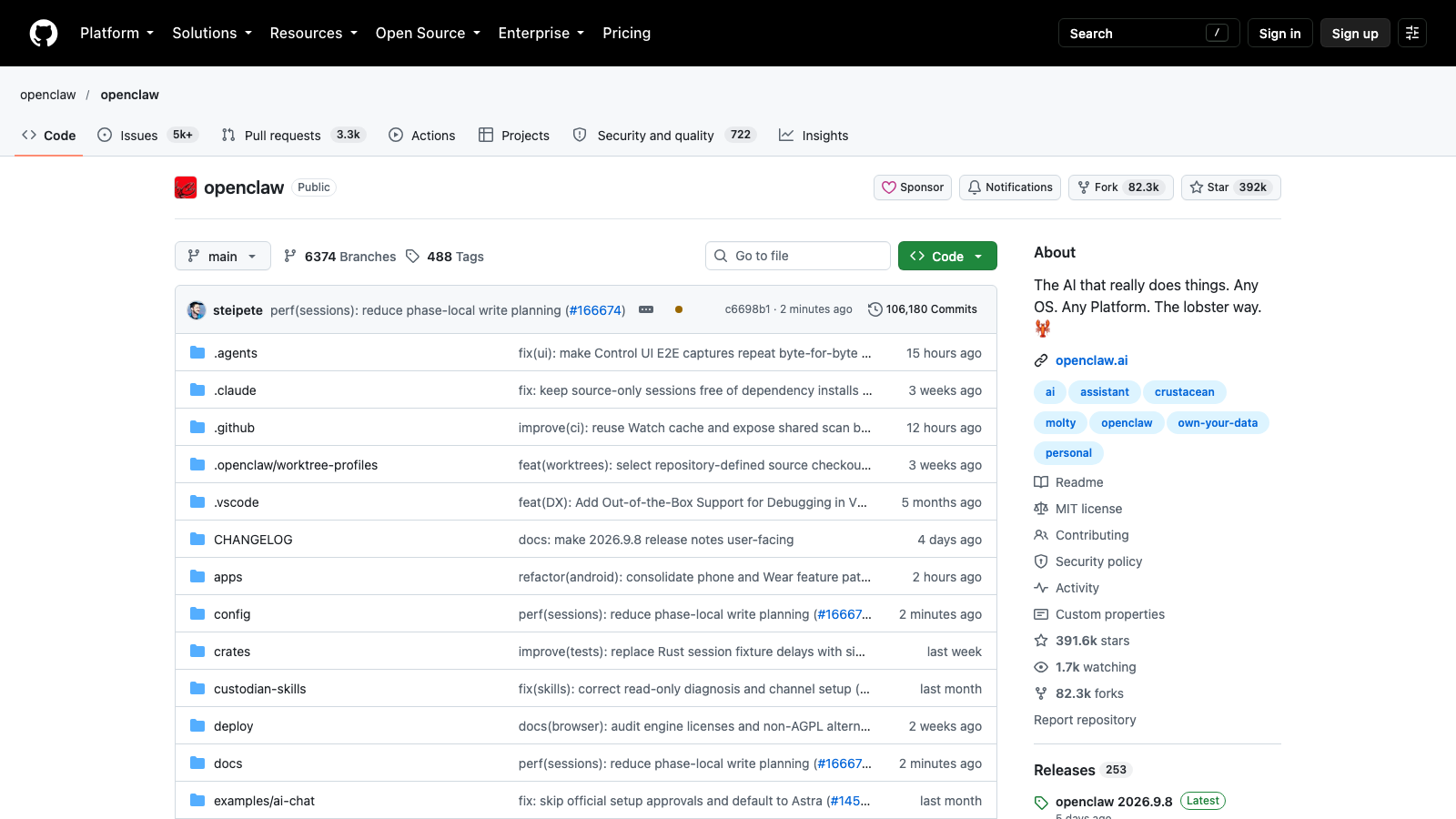
A local AI agent that automates tasks across 50+ services, running on your machine with Claude, GPT or local models. MIT-licensed, 392k GitHub stars as of October 2026, last pushed 19 August 2026.
The star count is not an accident. OpenClaw is the tool that proved personal AI agents can work, and it did it without a subscription. You install it, point it at your own keys, and it runs on your machine. That model is why projects like Hermes Agent (243k stars) exist.
Free and open source. No paid tier (checked 18 September 2026).
The comparison table
All 12 picks in one table, sorted by category:
| Tool | Best for | Open source | Free tier | Entry price | Checked |
|---|---|---|---|---|---|
| LangGraph | Production workflows | Yes | Yes | $39/mo | Sep 2026 |
| Mastra | TypeScript agents | Yes | Yes | $250/mo | Sep 2026 |
| CrewAI | Multi-agent teams | Yes | Yes | Contact | Sep 2026 |
| CopilotKit | Agent UI in apps | Yes | Yes | $39/mo | Sep 2026 |
| Cline | VS Code coding agent | Yes | Yes | BYOK | Sep 2026 |
| OpenCode | Terminal coding agent | Yes | Yes | BYOK | Sep 2026 |
| Devin AI | Hosted coding agent | No | Yes | $20/mo | Sep 2026 |
| Browser Use | Browser automation | Yes | Yes | $29/mo | Sep 2026 |
| Multica | Agent orchestration | Source-available | Yes | Not published | Sep 2026 |
| Orca | Parallel worktrees | Yes | Yes | Contact | Sep 2026 |
| Mem0 | Agent memory | Yes | Yes | $19/mo | Sep 2026 |
| Langfuse | Observability | Yes | Yes | $29/mo | Sep 2026 |
What I would skip
Four tools I looked at and decided against recommending:
AutoGPT made autonomous agents famous in 2023. The project still exists, but Microsoft put it in maintenance mode in October 2025 and points new users to Microsoft Agent Framework. Last push: 15 April 2026. If you are starting fresh, skip it. See What Happened to Microsoft AutoGen for the full timeline.
BabyAGI was the other 2023 breakout. Last push: 31 January 2026. Same story: proved an idea, production teams moved on.
AgentVerse has 5,112 stars but last pushed 9 September 2024. That is over two years without a commit. Abandoned.
SuperAGI has 17,656 stars and last pushed 22 January 2025. Twenty months without activity in a field that moves weekly.
The test is simple: if the repo has not been touched in 12+ months, you are adopting unmaintained code. The ideas might be good. The code is not getting security patches.
FAQ
What is the difference between an AI agent and a framework?
An agent is a running system that takes goals and executes tasks. A framework is a library you use to build agents. LangGraph and CrewAI are frameworks. Cline and OpenClaw are agents. Multica is neither: it orchestrates agents you already have.
Do I need to code to use AI agents?
For the agents in this post, yes. Cline and OpenCode assume you can read their output and fix mistakes. CrewAI and LangGraph are Python libraries. If you want a no-code agent, look at AgentOne (free tier with 100 credits/month, Pro $8.99/month).
What do AI agents cost to run?
The framework is usually free. The cost is the model inference. A coding agent doing real work burns $5-20 of tokens per day at API rates, depending on how much context it carries. I estimated $23 for 20 tasks in a few hours using Claude Code with Multica; see the setup post for the breakdown.
Which agent framework is best for production?
LangGraph. The explicit state graph, checkpointing and human-in-the-loop support are what production means in this context. CrewAI is faster to start but gives you less control over what runs when.
Are there AI agents that work offline?
OpenClaw and OpenCode can both point at local models via Ollama. The model runs on your machine, nothing leaves your network. Performance depends on your hardware.
Related reading
- The Agent Stack: 10 Tools That Grew Up Around Coding Agents covers sandboxes, tool access and observability
- What Happened to Microsoft AutoGen explains the three-way split
- I Gave My Coding Agents a Task Board is the detailed Multica walkthrough
- AutoGPT vs CrewAI vs LangGraph comparison page