Microsoft AutoGen still exists, but Microsoft stopped building it. The repository has carried a maintenance-mode banner since 2 October 2025, the last Microsoft release is autogen-agentchat 0.7.5 from 30 September 2025, and Microsoft sends new users to Microsoft Agent Framework, which reached 1.0 on PyPI on 2 April 2026. Meanwhile the original AutoGen authors run a fork called AG2, and that fork owns the autogen package name on PyPI.
"AutoGen" now points at three projects, and the one you get depends on which pip install line your tutorial used. On 5 October 2026 I installed all five candidate packages in clean virtual environments (Python 3.14.7, macOS) and checked what each one puts on disk and what imports work. I did not build or run an agent with any of them, so this post has no verdict on output quality. It covers status, packages and cost.
AutoGen split three ways in two years
The timeline, from the repositories and PyPI upload dates:
- August 2023:
pyautogen0.0.1 lands on PyPI. AutoGen is a Microsoft Research project built around agents that talk to each other in a group chat. - 13 November 2024:
ag20.3.2b2, the fork's first PyPI upload. The original AutoGen authors run AG2 outside Microsoft. - 9 January 2025: Microsoft ships the rewrite,
autogen-agentchat0.4.0, withautogen-coreunderneath. Code written for 0.2 needs a migration to run on it. - 1 October 2025: Microsoft announces Agent Framework, merging AutoGen and Semantic Kernel. The first
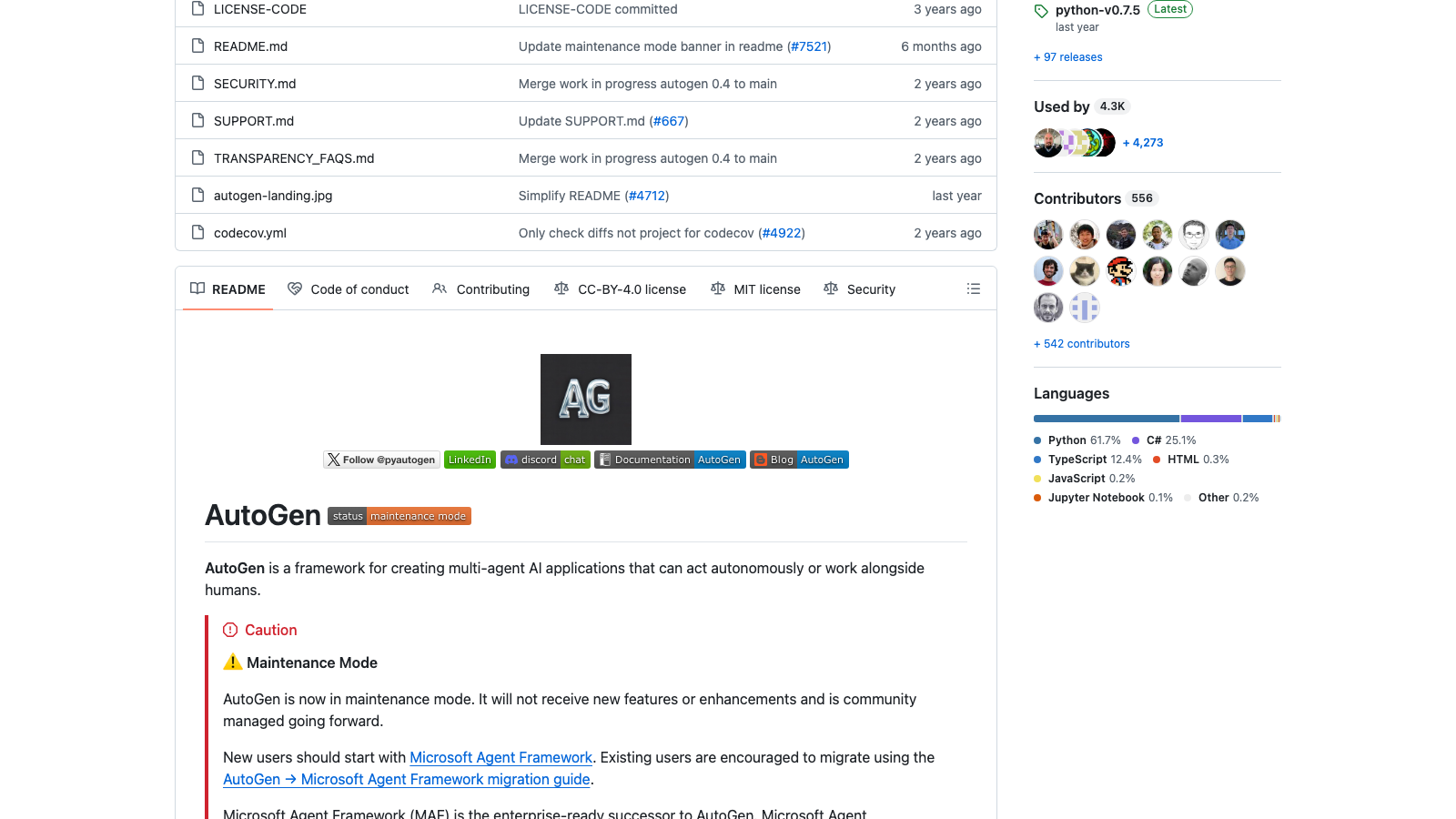
agent-frameworkbeta reaches PyPI the same day. - 2 October 2025: the AutoGen README gains the maintenance banner: "It will not receive new features or enhancements and is community managed going forward."
- 2 April 2026:
agent-framework1.0.0 goes up on PyPI. Microsoft's announcement gave 3 April as the GA date. - 27 July 2026: AG2 tags v1.0.0.
Developers noticed. Richard Seroter summed up the reaction on X the week Microsoft announced it:
As of today the activity tells the same story. Microsoft's AutoGen repo has 61,258 GitHub stars and its last push was 15 April 2026. Agent Framework has 13,945 stars and shipped agent-framework 1.20.0 on 2 October 2026. AG2 has 4,976 stars and shipped 1.1.2 on 3 October 2026.
Five pip commands, three different frameworks
The package names are the trap. I installed each one into an empty virtualenv and recorded what arrived:
| Command | You get | Version (upload date) | Packages | Size on disk | import autogen works? |
|---|---|---|---|---|---|
pip install autogen |
AG2 "classic" (source repo ag2ai/ag2classic), maintenance mode |
0.14.1 (30 Jun 2026) | 22 | 55 MB | Yes |
pip install ag2 |
AG2 1.x, new ag2 module |
1.1.2 (3 Oct 2026) | 14 | 39 MB | No |
pip install pyautogen |
Proxy for Microsoft's autogen-agentchat |
0.10.0, pulls 0.7.5 | 12 | 45 MB | No |
pip install autogen-agentchat |
Microsoft AutoGen 0.7, frozen | 0.7.5 (30 Sep 2025) | 11 | 45 MB | No |
pip install agent-framework |
Microsoft Agent Framework, every connector | 1.20.0 (2 Oct 2026) | 201 | 662 MB | No |
Package counts exclude pip. Sizes are the venv's lib folder.
Three things in that table will cost you an afternoon if you miss them:
pyautogennow installs Microsoft's 0.7. Old 0.2 tutorials start withpip install pyautogenandimport autogen. Today that install gives you Microsoft's 0.7 packages, andimport autogenfails withModuleNotFoundError. The 0.2-styleConversableAgentAPI lives on inpip install autogen, which is AG2's package, and AG2 froze that package too.- AG2 1.x renamed its module.
pip install ag2gives youimport ag2, with classes such asAgent,TaskandToolkit. If you want the classic API from AG2, you installautogen, notag2. - The Agent Framework meta-package is heavy. 201 packages and 662 MB, because it pulls every connector: Anthropic, Bedrock, Gemini, Ollama, Redis, Cosmos, Copilot Studio and more, many of them still on beta version numbers.
pip install agent-framework-core agent-framework-openaigave me 21 packages and 67 MB, andfrom agent_framework import Agent, toolworked from that.
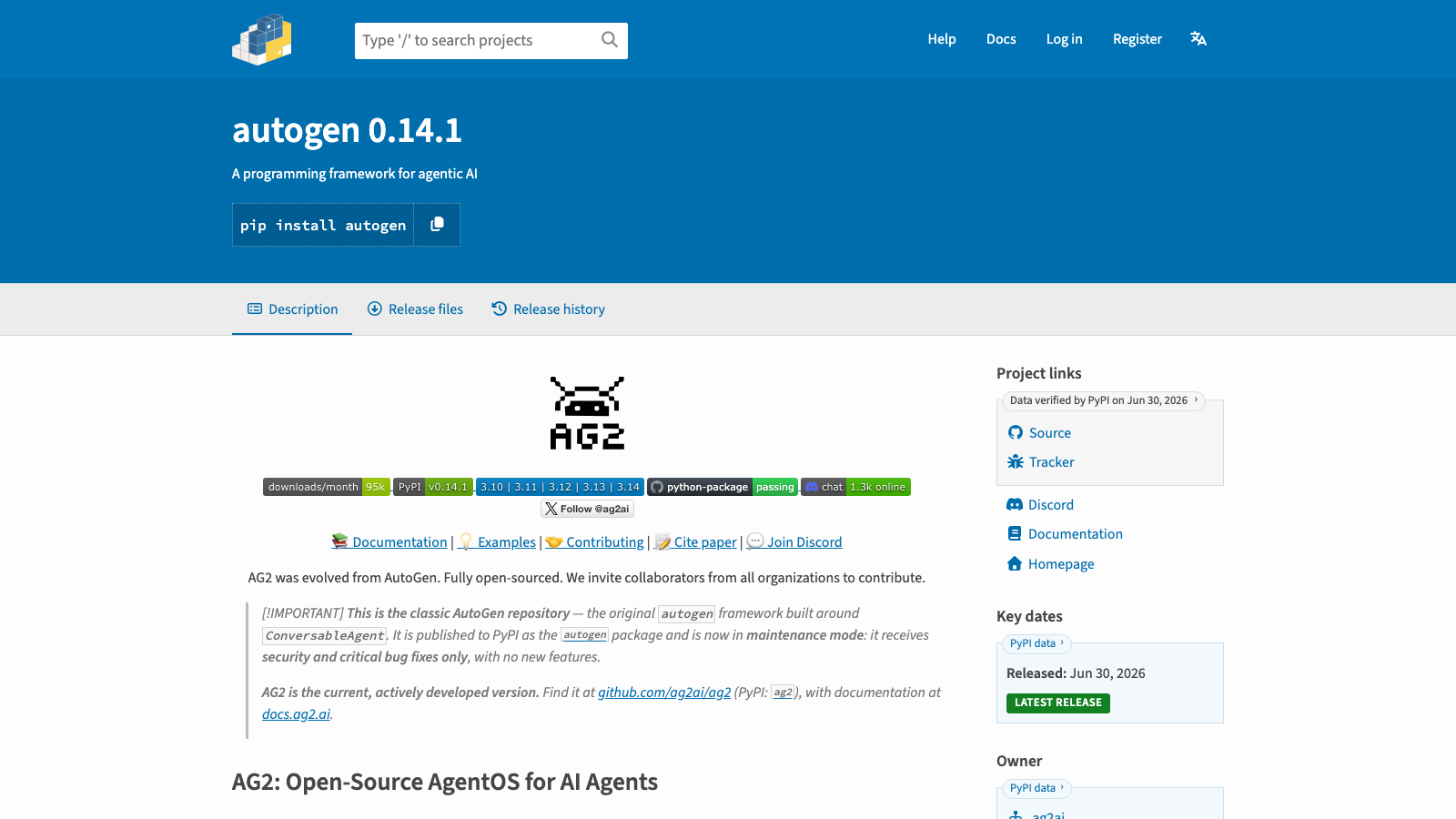
The PyPI page for autogen spells it out. It carries the AG2 logo and a notice that this classic package now gets security and critical bug fixes only:
If you pin dependencies, pin the package name you meant. A requirements file that says autogen and a colleague who expects Microsoft's code are two people reading different projects.
Microsoft AutoGen is frozen, and the README says what that means
Maintenance mode on this repo means bug and security fixes, no features, and the community runs it. The commit history matches. Since the banner went up, the main branch has taken five commits: two on 4 October 2025, then three in March and April 2026, among them a fix that restricts provider loading to trusted namespaces and an AutoGen Studio hardening pass.
AutoGen 0.7.5 still installs and imports. If you have a working 0.4+ app on it, nothing breaks today. You give up new model features, new tool protocols and any chance of Microsoft fixing a non-security bug on your schedule. For a demo or an internal tool, that may be fine. For anything you plan to run for two years, it is a migration you are postponing.
AutoGen Studio, the no-code GUI, follows the same pattern. The last autogenstudio release on PyPI is 0.4.2.2 from 27 May 2025.
Agent Framework keeps the agent and replaces the team
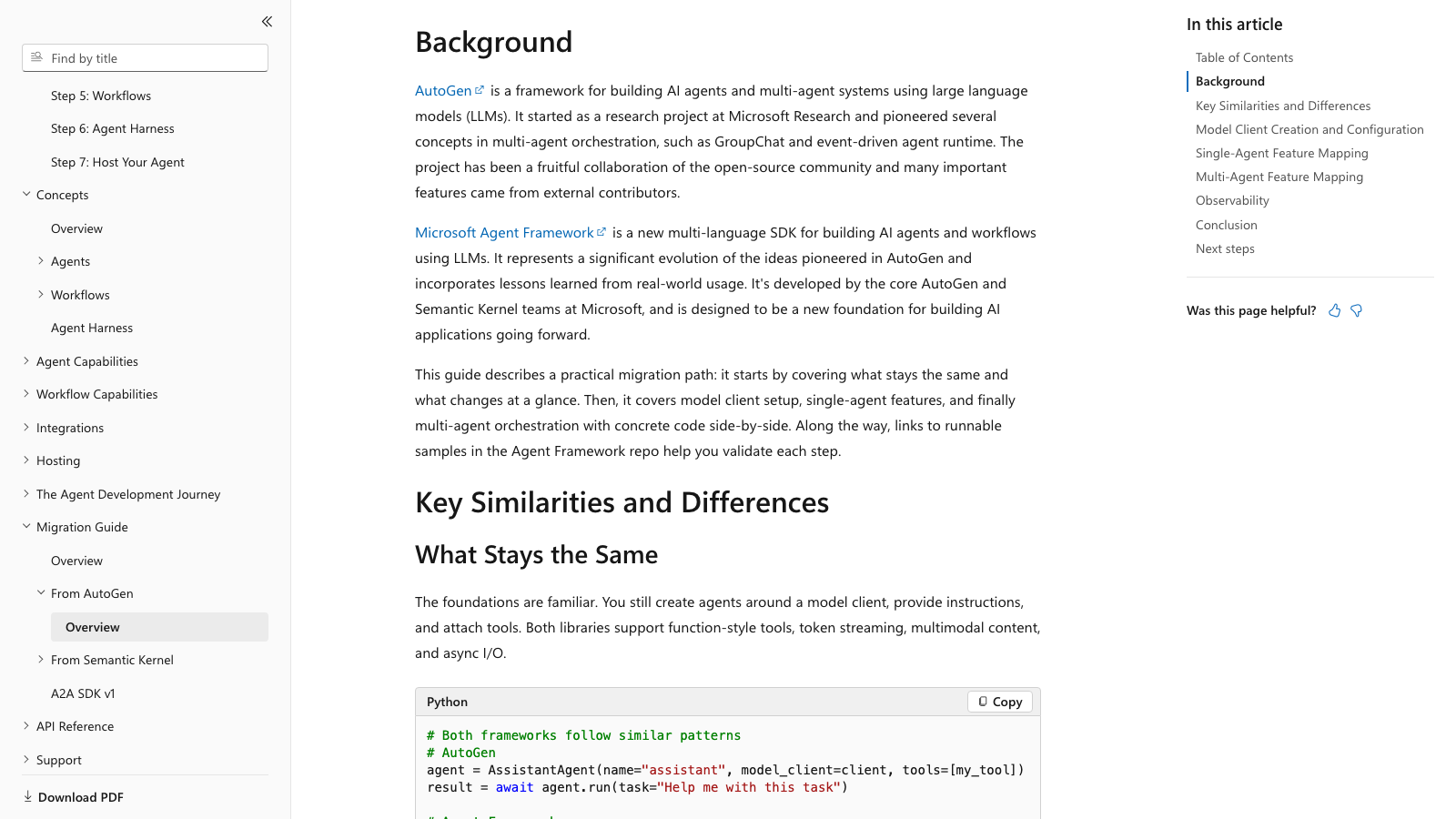
Microsoft's migration guide is the best primary source for the differences. The single-agent code looks almost the same:
# AutoGen 0.7
agent = AssistantAgent(name="assistant", model_client=client, tools=[my_tool])
result = await agent.run(task="Help me with this task")

# Agent Framework 1.x
agent = Agent(name="assistant", client=client, tools=[my_tool])
result = await agent.run("Help me with this task")
The guide lists the changes that matter for a port:
- Agents are stateless.
AssistantAgentkept conversation history in its own state. An Agent FrameworkAgentdoes not, and you carry history in anAgentSession. - Tool loops run to completion. AutoGen needed
max_tool_iterations. Agent Framework keeps calling tools until the task is done, with its own loop guard. - Tools use a decorator.
FunctionToolwrappers become@tool, with the schema inferred. - Teams become workflows.
RoundRobinGroupChatandGraphFlowgive way to a typedWorkflowbuilt withWorkflowBuilder, plus ready-madeSequentialBuilderandConcurrentBuilderorchestrations. Workflows support checkpointing and pausing for human input.
The last point is the expensive one. AutoGen's identity was the group chat: agents taking turns in a shared conversation. Agent Framework routes typed messages along graph edges. If your app is one agent with tools, the port is renames plus session handling. If it is a group chat with a selector, you are redesigning the control flow.
AG2 buys 0.2 code time, and its new API is a rewrite too
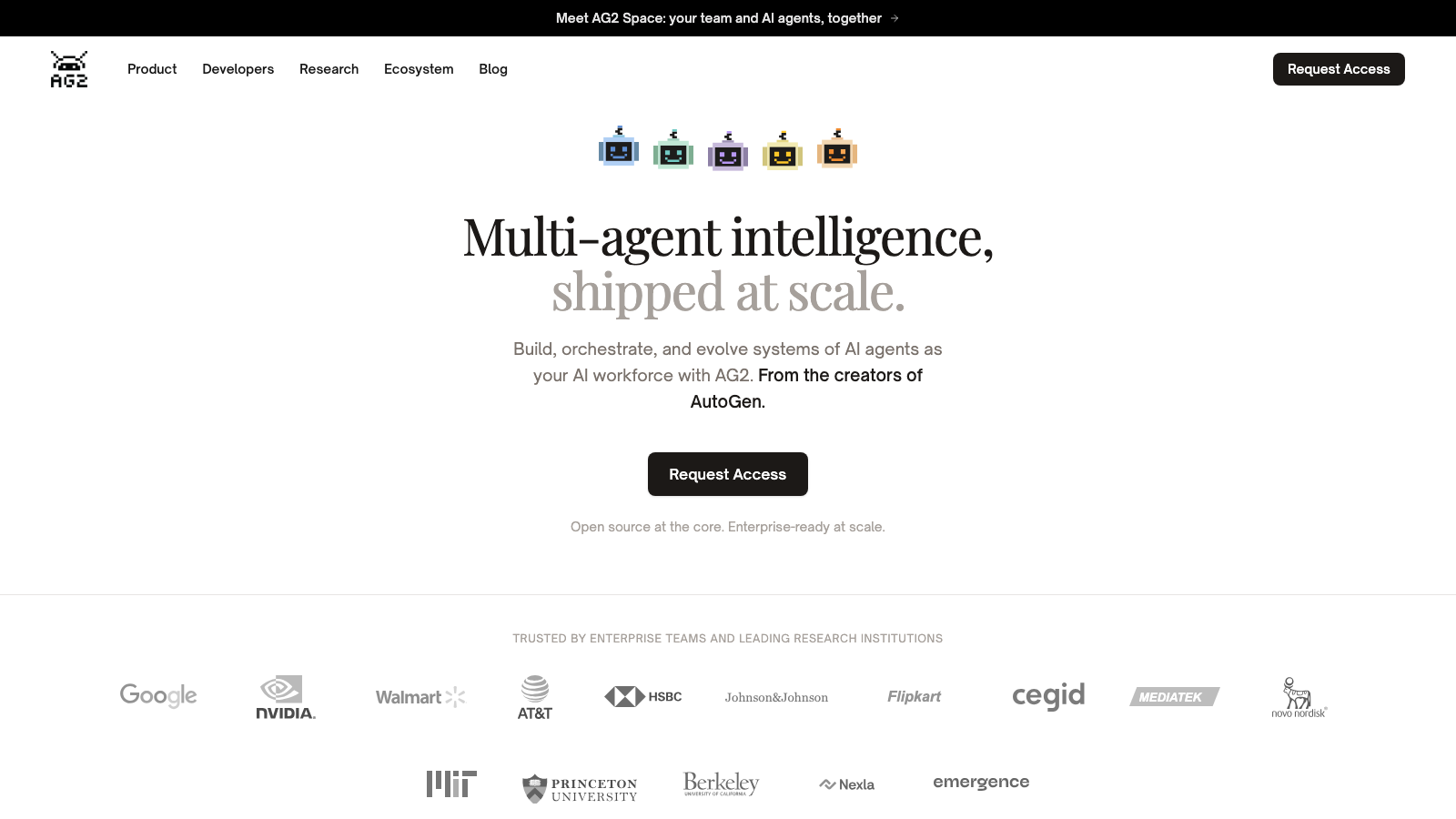
AG2 is Apache 2.0, run by the people who wrote the original AutoGen paper, and it ships often (five releases between 11 September and 3 October 2026). Its homepage leads with "From the creators of AutoGen" and a Request Access button.
For AutoGen users it offers two packages:
pip install autogenkeeps the 0.2-era API (ConversableAgent, group chats), and AG2 has put it in maintenance mode: security and critical bug fixes only. It is the cheapest way to keep 2024 code running while you plan the move.pip install ag2is the 1.x line, the one AG2 develops. AG2's roadmap says v1.0 drops the classicConversableAgentAPI, so treat it as a new framework that shares a history.
The trade-off is backing. Microsoft Agent Framework has Microsoft behind it, Azure AI Foundry integration, and a promise of long-term support in the AutoGen README. AG2 has a smaller team and 4,976 stars against 13,945. I would not pick AG2 for a regulated enterprise deployment. For a side project on 0.2 code, AG2 classic keeps it running while you decide where to port it.
My own listing for AutoGen is wrong, too
Checking our AutoGen listing for this post, I found two problems. The meta description Google shows says "Paid pricing", and the pricing panel says "No free tier" next to "Free and open-source from Microsoft". AutoGen has never charged anything. The listing also says nothing about maintenance mode. I have flagged both for a fix rather than editing the database from a blog post, so the panel may still show them when you read this.
That listing pulled 589 Google impressions in the last 28 days, and searches like "autogen pricing" and "autogen ai pricing" sit in our Search Console data. People want a price for AutoGen, and the next section gives it.
AutoGen pricing: the framework is free, the model calls are your bill
Every option in this post is free to install. Your costs come from the model API calls your agents make and from whatever you run alongside them:
| Option | License | Framework cost | Paid layer you may add |
|---|---|---|---|
| Microsoft AutoGen 0.7 | Code MIT (docs CC-BY-4.0) | $0 | None from Microsoft |
| AG2 | Apache 2.0 | $0 | None required |
| Microsoft Agent Framework | MIT | $0 | Azure AI Foundry hosting, billed by Azure |
| CrewAI | Open source | $0 (Basic) | Enterprise, contact sales |
| LangGraph | Open source | $0 (Developer) | Plus $39/month for LangSmith deployment |
CrewAI and LangGraph figures come from our pricing records, read off crewai.com/pricing and langchain.com/pricing on 18 September 2026.
Group chats send the whole conversation back to the model on every turn, so token use grows with each agent you add. Before you pick a framework on features, put an observability tool in front of it. AgentOps is free up to 5,000 events and $40/month for Pro (checked 19 September 2026). Langfuse is free on Hobby with 50k units a month, $29/month on Core, and free to self-host (checked 16 September 2026). Either one tells you which agent is burning tokens.
The rest of the 2023 agent class went quiet too
AutoGen was one of the 2023 breakout agent projects. BabyAGI, the other one people still search for, shows the same pattern at a smaller scale: 22,362 stars and a last push on 31 January 2026. Both proved an idea in 2023, and production teams moved to frameworks with a company behind them. Codeium and Phind followed different routes to a similar end, covered in What Happened to Codeium and Why Phind Shut Down.
FAQ
What is AutoGen?
AutoGen is an open-source Python framework from Microsoft Research for building apps where several LLM agents talk to each other and call tools. Microsoft put it in maintenance mode in October 2025 and replaced it with Microsoft Agent Framework. The name also lives on in AG2, a fork by the original authors.
Is AutoGen free?
Yes. AutoGen, AG2 and Microsoft Agent Framework cost nothing to install. You pay your model provider (OpenAI, Anthropic, Azure and so on) per token, plus any hosting or observability you add.
Is the Microsoft AutoGen framework still maintained?
Only for bug and security fixes. The README says it "will not receive new features or enhancements". The last Microsoft release is 0.7.5, from 30 September 2025.
My plan for an AutoGen project in October 2026
If you are starting fresh, skip AutoGen and compare Microsoft Agent Framework with CrewAI and LangGraph on your own task. Our AutoGen vs CrewAI, AutoGen vs LangGraph and CrewAI vs LangGraph pages line up pricing and features.
If you run AutoGen 0.4+ code, budget the port to Agent Framework and start with single agents, since group chats need the most rework. If you run 0.2 code, check your requirements file first. pyautogen no longer gives you the API that code expects. autogen (AG2 classic) does, on a package that now gets security fixes only, so pin it and schedule the port.
For the tools that grew up around coding and agent frameworks this year, see The Agent Stack.
Package checks run on 5 October 2026 in clean virtualenvs on macOS with Python 3.14.7. Release dates come from PyPI upload times and GitHub, read the same day.