


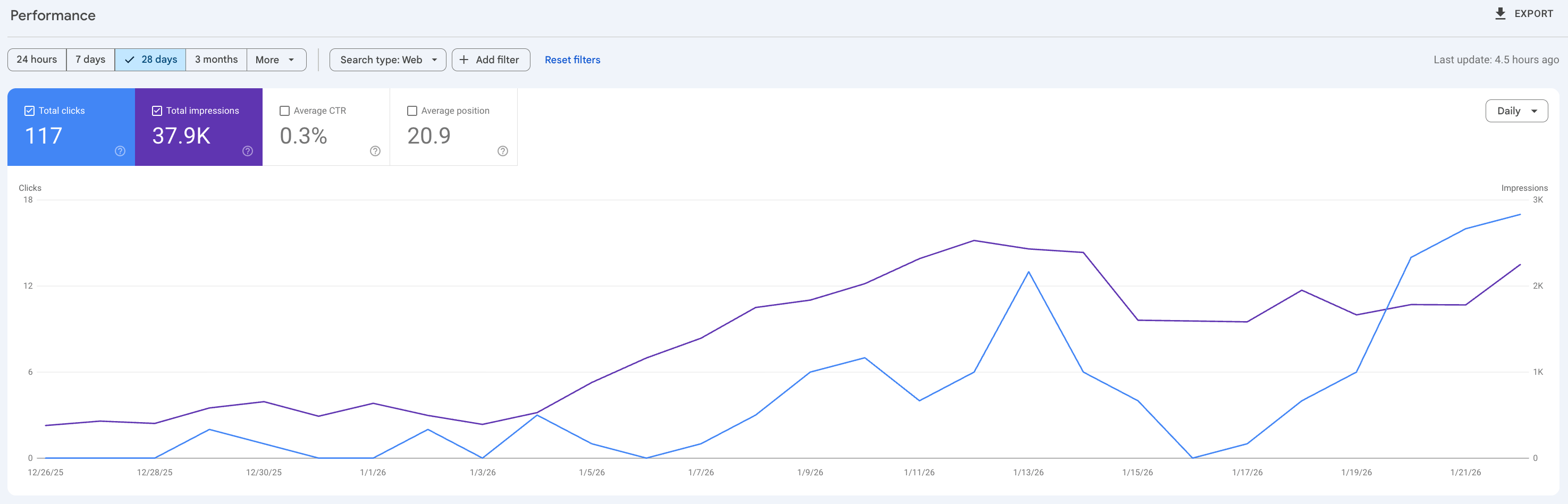
My site was getting 1,600 impressions per day from Google. Only 5 people clicked through.
That's a 0.3% click-through rate. Which means 99.7% of people saw my content in search results and said "nope."
I spent 2 hours feeding Search Console data to Claude and rewrote 50 meta titles. Here's what happened.
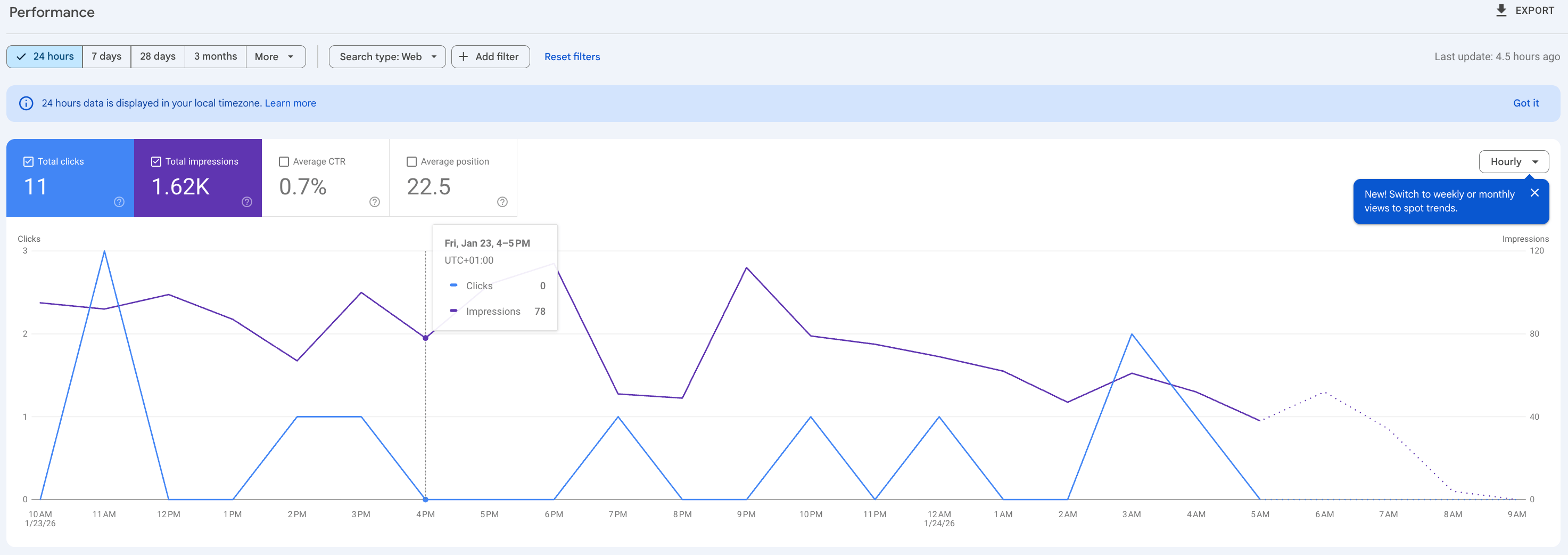
The problem was simple: my titles were boring. They described each page in the most generic terms, giving no one a reason to click. After three weeks of Google re-indexing the new titles, my CTR climbed to 0.7%. That might not sound like much, but it means I went from 5 to 11 clicks per day with the exact same search visibility. Over a month, that's 180 extra visitors without writing a single new post.
The Problem: Pages That Get Seen But Never Clicked
I run intelligenttools.co, an AI tools directory and blog. I write technical reviews of tools I actually use as a senior developer. The content is solid - people who find it stay for 4+ minutes reading through my posts.
But most people never find it because my titles were invisible.
My Grammarly tool page had 910 impressions over 28 days with zero clicks. Not a single person out of 910 thought "Grammarly - AI Writing Tool" was worth clicking on. The Phind shutdown post I wrote? 176 impressions, zero clicks. My Stack Overflow developer survey analysis? 130 impressions, zero clicks.
The only page performing decently was my Claude Code workflow post, which managed a 7.7% CTR on just 13 impressions. Everything else was bleeding potential traffic because the titles told people exactly what the page was without giving them any reason to care.
My site-wide average sat at 0.3%. For context, the industry-standard CTR is between 2% and 5%, depending on your position in search results. At position 22, which was my average, I should have been getting at least 1-2%. I was losing somewhere around 130-150 potential visitors every single day just because my titles were boring.
The Titles I Had (And Why They Failed)
Take my Grammarly page. The title was "Grammarly - AI Writing Tool." That's it. Just a description of what Grammarly is, with zero personality and no reason for anyone to care. It's the kind of title you'd see on 10,000 other websites.
My ChatGPT vs Claude Code comparison had the inspired title of "ChatGPT vs Claude Code - A Comparison." Wow. Really going out on a limb there. Everyone does "vs" posts, and mine looked exactly like every other one. The worst thing is that it's not your content being evaluated here; it's the titles. So even if you have a great article and some really decent, helpful points to convey, it doesn't matter because the meta information is basically getting in the way.
The Stack Overflow survey post was titled "Stack Overflow Developer Survey 2025," which made it sound like I'd just copied and pasted the survey results. Why would anyone read my version instead of going directly to Stack Overflow?
Even the Phind shutdown post, which was actually somewhat timely, had a generic title: "Phind Shut Down: What Developers Need to Know." Not terrible, but not specific enough to stand out.
Every single title followed the same boring pattern: describe the thing in the most literal way possible. Zero personality. Zero curiosity. Zero reason to click instead of the nine other results on the page.
The Claude Workflow (That Actually Worked)
I didn't want to manually brainstorm 50 new titles. That would take hours, and my judgment was clearly broken given the 0.3% CTR. So I fed the problem to Claude and let it handle the pattern recognition.
The first step was exporting my Search Console data. I went to Performance, clicked on Search Results, filtered for the last 28 days, and exported the Pages tab to CSV. This gave me every page on my site with total impressions, total clicks, average CTR, average position, and the top queries driving traffic to each page.
Then I opened Claude and explained the problem. I didn't use some elaborate prompt engineering technique. I just told it what was broken and what I needed.
I'm rewriting meta titles for my AI tools directory and blog. I write honestly,
technical reviews of AI tools as a senior developer. My audience is developers,
founders, and technical people.

Problem: My CTR is 0.3%. Pages get hundreds of impressions but almost no clicks.

Here's my Search Console data for the last 28 days:
[paste CSV export]

For each page with <1% CTR and 100+ impressions, suggest a new meta title that:

1. Includes the top-performing search query if relevant
2. Adds a specific number, timeframe, or dollar amount when possible
3. Makes people curious but stays honest (no clickbait)
4. Keeps it under 60 characters for mobile display
5. Matches my technical, no-BS voice

Focus on the pages with the most impressions first - that's where I'm losing the most traffic.

Show me before/after examples with your reasoning.
Claude suggested 52 title rewrites. I went through each one and kept 35 as-is because they were genuinely better than what I had and felt authentic. Another 12 needed modifications to better match my voice. And I rejected 5 outright because they were too clever or too salesy.
The ones I rejected were things like "This AI Tool Changed Everything," which was way too vague, or "You Won't Believe What Grammarly Does Now," which was pure clickbait garbage. Some had excessive punctuation or ALL CAPS. Claude's first drafts leaned too hard toward "marketing blog" territory, so I had to push it back toward technical and direct.
After finalizing the titles, I spent about 45 minutes updating them in my CMS. I copied each new title, updated the corresponding meta description to match, double-checked character counts to make sure nothing got cut off on mobile, and submitted everything to Google Search Console for re-indexing.
The whole process from export to implementation took about two hours.
The New Titles (Before/After)
Here's what actually changed:
Example 1: The Grammarly Page
Before: "Grammarly - AI Writing Tool" After: "Grammarly After 2 Years: Why I'm Considering Canceling ($144/year)."
Why it works:
- Specific timeframe (2 years)
- Real dollar amount ($144/year)
- Honest conflict (considering canceling)
- Implies I've actually used it, which I do (not just reviewing)
Example 2: Stack Overflow Survey
Before: "Stack Overflow Developer Survey 2025" After: "82% of Developers Use AI - What the Stack Overflow Survey Won't Tell You"
Why it works:
- Lead with the shocking stat (82%)
- Promise of insider insight ("won't tell you")
- Implies analysis beyond the raw data
Example 3: Phind Shutdown
Before: "Phind Shut Down: What Developers Need to Know" After: "Phind Shut Down Yesterday: What Happened and Which Tools to Use Instead"
Why it works:
- Urgency ("yesterday" - even if not literally true)
- Specific value ("which tools to use instead")
- Answers the immediate question
What Happened After 3 Weeks
SEO is painfully slow. You can't change titles and see results the next day. You have to wait for Google to re-crawl your pages, re-index them with the new titles, and then gradually adjust rankings based on the new click-through rates people are giving you.
The first week was completely flat. My CTR stayed at 0.3% because Google hadn't re-crawled most of my pages yet. Nothing changed. It was frustrating but expected.
Week two showed the first signs of movement. My CTR crept up from 0.3% to 0.5% as some pages started showing new titles in search results. Still not dramatic, but at least something was happening.
By week three, I hit 0.7% CTR. That's a 133% improvement from baseline, which sounds amazing until you realize I went from 5 clicks per day to 11 clicks per day. It's progress, but not the overnight transformation you might hope for.
The current status after three weeks shows my site-wide CTR at 0.7%, yielding about 11 daily clicks from the same impression volume. That works out to roughly 180 extra visitors per month from two hours of work. Not world-changing, but definitely worth it.
Some pages improved dramatically, while others still show old titles in search results. My Gemini vs Claude privacy post hit 6.8% CTR on 22 impressions, about 10x my previous site average. The Claude Code workflow post climbed to 8.1% on 19 impressions. But my Grammarly tool page is still showing 0.4% because Google is being slow to re-index it, even though it now has 234 impressions over the tracking period.
What I'm really watching in Google Search Console is CTR by individual page to see which new titles actually work, changes in average position to make sure new titles aren't hurting my rankings, shifts in what queries are driving traffic now that titles are different, and impression stability to confirm I didn't accidentally kill my visibility by changing everything.
What Actually Worked (And What Didn't)
Adding specific numbers made titles immediately more concrete. When I changed "Grammarly - AI Writing Tool" to include "After 2 Years" and "$144/year," people could tell this was based on real experience, not just generic marketing copy. Generic claims are invisible in search results. Numbers are real, and they catch your eye.
Personal experience signals performed way better than objective descriptions. "I spent $500" beats "These tools cost" every single time because people trust someone who actually used the tools over someone just summarizing the specifications from a product page.
Claude did something smart that I wouldn't have thought of on my own. It analyzed what people were already searching for and incorporated those exact terms into the new titles. I wasn't guessing what might work or trying to be creative. I was using actual data about what people type into Google.
Controversy combined with honesty created more compelling titles. "Why I'm Canceling" is inherently more interesting than "Review" because it suggests I'm willing to criticize something. When you're honest about negatives, people believe your positive claims more.
Developer-specific language worked better than broad appeals. Terms like "47 commits" and "Ralph Loop" are things developers immediately recognize. My original strategy of using generic titles to appeal to everyone meant I was actually appealing to no one. Specific titles for my actual audience performed way better.
What didn't work was expecting instant results. The first week was brutal because nothing changed. You have to wait 4-6 weeks for Google to fully re-index and re-rank with new titles, and there's no way to speed that up.
I also learned not to blindly accept Claude's first drafts. The initial suggestions were too "marketing blog" in tone. Titles like "Transform Your Workflow With These AI Tools" got rejected immediately because they didn't sound like me. I had to push Claude toward technical and direct language.
Changing everything at once was probably a mistake. I should have tested 10 titles first, waited two weeks to see results, then rolled out the rest. Now I can't tell which specific types of changes worked best because I changed everything simultaneously.
Some of the titles Claude suggested were genuinely good but not right for my blog. They sounded great for someone else's audience. I had to rewrite about 12 of them to actually match my voice and the technical tone my readers expect.
The Exact Workflow You Can Copy
Here's what you actually need to do if you want to try this yourself.
First, you need Google Search Console access and at least 1,000 monthly impressions to have enough data to work with. If your CTR is already above 2%, you probably don't need this. And obviously, you need a couple of hours to actually do the work.
Start by exporting your data from Google Search Console. Go to Performance, then Search Results, set your date range to the last 28 days, click on the Pages tab, and download the CSV export.
Open that CSV and look for your problem pages. You want pages with more than 100 impressions because anything less doesn't have enough volume to matter, a CTR under 1% because that's clearly underperforming, and a position better than 30 because if you're ranking on page 5, you need to fix your ranking before you worry about click-through rate. For me, that was 47 pages that fit all three criteria.
Now open Claude and paste in your CSV data with the prompt I used earlier. If you're using the free claude.ai interface and you have 100+ pages, you might need to break it into a few chunks. With the API, you can do it all at once.
When you get Claude's suggestions back, don't blindly accept everything. Go through each title rewrite and ask yourself if it sounds like you, if it's honest or clickbait, if you'd actually click on it yourself, and if it matches what the page delivers. I modified about a quarter of Claude's suggestions because they didn't quite match my voice.
Then update your meta titles in your CMS. Make sure you're changing the meta title tag that shows in search results, not just the page heading that visitors see. Most platforms let you edit both separately.
After you've changed everything, go back to Google Search Console and use the URL Inspection tool to request re-indexing. Type in each URL you changed and click "Request Indexing." You can only do about 10-20 per day, so prioritize your highest-impression pages first.
Then comes the hard part: waiting 4-6 weeks while Google recrawls your pages, reindexes them with the new titles, and re-ranks them based on how people respond to the changes. Check Search Console weekly to watch for progress, but don't expect major changes for at least a month.
Should You Actually Do This?
This works if your CTR is genuinely low. If you're getting under 2%, there's clear room for improvement, and title optimization can help. You also need enough traffic volume to make it worth the effort - if you're getting 1,000+ monthly impressions from search, you have enough data to work with.
It's most effective when your titles are generic descriptions like "Tool Name - What It Does," because there's obvious room for improvement. And if you write technical content for developers or other specialized audiences, specific language tends to work better than broad appeals.
But you probably shouldn't bother if your CTR is 3% or higher, since you're already doing fine. If your actual problem is the content itself rather than its title, fixing the titles won't help. Don't do this if you just changed your titles in the last 30 days - wait for those results first before changing everything again. And if you don't have Search Console data set up, you're basically flying blind.
Position matters too. If you're ranking on page 5 or worse, you need to fix your rankings before you worry about click-through rate because almost nobody scrolls that far anyway.
The Math That Actually Matters
Let's say you're in my situation with 1,600 impressions per day and a 0.3% CTR. That gives you 5 clicks per day, totaling 150 per month.
If I can just hit 1% CTR, which is still below average but realistic, that's 16 clicks per day instead of 5. Over a month, that's 480 clicks, meaning 330 extra visitors monthly from the exact same search visibility.
If I eventually hit 5% CTR, which is good but not amazing, I'd be getting 80 clicks per day or 2,400 per month. That's 2,250 extra visitors monthly compared to where I started.
Right now, I'm sitting at about 2,000 total monthly visitors. If I can get my CTR up to 5%, I'd be looking at 4,400 monthly visitors without writing a single new piece of content. That's better ROI than spending months writing 10 new blog posts that might not even rank.
I'm not there yet. Three weeks in, I'm at 0.7% CTR, which is progress but nowhere near the goal. Still, two hours of work for a potential 2x increase in traffic seems worth the gamble.
What This Really Means for AI + SEO
Everyone's panicking about AI-generated content killing SEO, but nobody talks about using AI to fix the boring mechanical parts that humans are terrible at.
I'm not using Claude to write my articles. The content, expertise, and testing and experience are still mine. What Claude did was analyze patterns I would have missed, generate 50 title variations in 5 minutes instead of spending 5 hours brainstorming, remove my emotional bias about what I think is clever, and handle all the tedious spreadsheet analysis I would have procrastinated on forever.
This is the practical use of AI that nobody seems to talk about. It's not replacing your job, writing your content, or doing your thinking. It's just handling the mechanical, data-driven tasks that take forever and that nobody actually enjoys doing.
The titles themselves are still based on my content and my experience. Claude just helped me figure out how to communicate that experience in a way that actually gets people to click.
My Honest Take After 3 Weeks
I changed my titles three weeks ago, and my CTR went from 0.3% to 0.7%. That's a 133% improvement, which sounds impressive until you realize it just means I went from 5 to 11 clicks per day.
But I'm only three weeks into what's realistically a 6-week process. Google is still re-indexing. Most of my high-impression pages are still showing the old, boring titles in search results because the re-crawl and re-index cycle is slow.
Are the pages that are showing new titles? They're performing way better. The Gemini vs Claude post is sitting at 6.8% CTR. The Claude Code workflow post hit 8.1%. If those numbers hold across all 47 pages once everything is fully re-indexed, I'm looking at maybe 3-4x my current search traffic.
I won't know for sure for another three weeks. But two hours of work for potentially 1,200 extra monthly visitors? Even if I only get half that, it's still worth it.
What to Do Next
If you want to try this yourself, start by checking your Search Console for pages with 100+ impressions and a CTR under 2%. Export that data, use the Claude prompt from this post to generate new title suggestions, review them carefully rather than blindly accepting everything, implement the changes in a single batch, and then wait at least 4 weeks before judging whether it worked.
Worst case, you spend two hours and learn what doesn't work for your audience. Best case, you double your search traffic without writing any new content.
I'll come back and update this post with full results once I hit the 30-day mark and can see which changes actually stuck.